Price every job the way it’ll get built.

Stralos is construction estimating software for New Zealand and Australian contractors. Start free on Starter.

Animation of Stralos, simplified: item 3.01 on an example job, from the tender pack to the client’s own workbook, priced
  1. Before: the rate is typed again into the client’s sheet, $349.96 instead of $439.96.
  2. Tender in: their schedule comes in with its numbering kept, so 3.01 stays 3.01.
  3. On the map: council pipes and property boundaries on LINZ aerial or Google Maps.
  4. Measure: 219.50 m taken off on the drawing, against 220 m scheduled.
  5. Price: the trench, the crew at 30 m a day and the suppliers near the job give $397.69 a metre at cost.
  6. Check and send: a tender review finding quotes the page it came from, and their Excel goes back priced.
  7. Plan it: the item on the tender programme, and what you’d need to hire.
See it recorded

An animation of Stralos, simplified, following item 3.01, 220 m of DN300 stormwater pipe, on an example job, Riverbend Stage 3. Recorded clips of each step are further down the page.

  • Before: the rate is typed again into the client’s spreadsheet as $349.96 instead of $439.96, leaving 220 m $19,800 short.
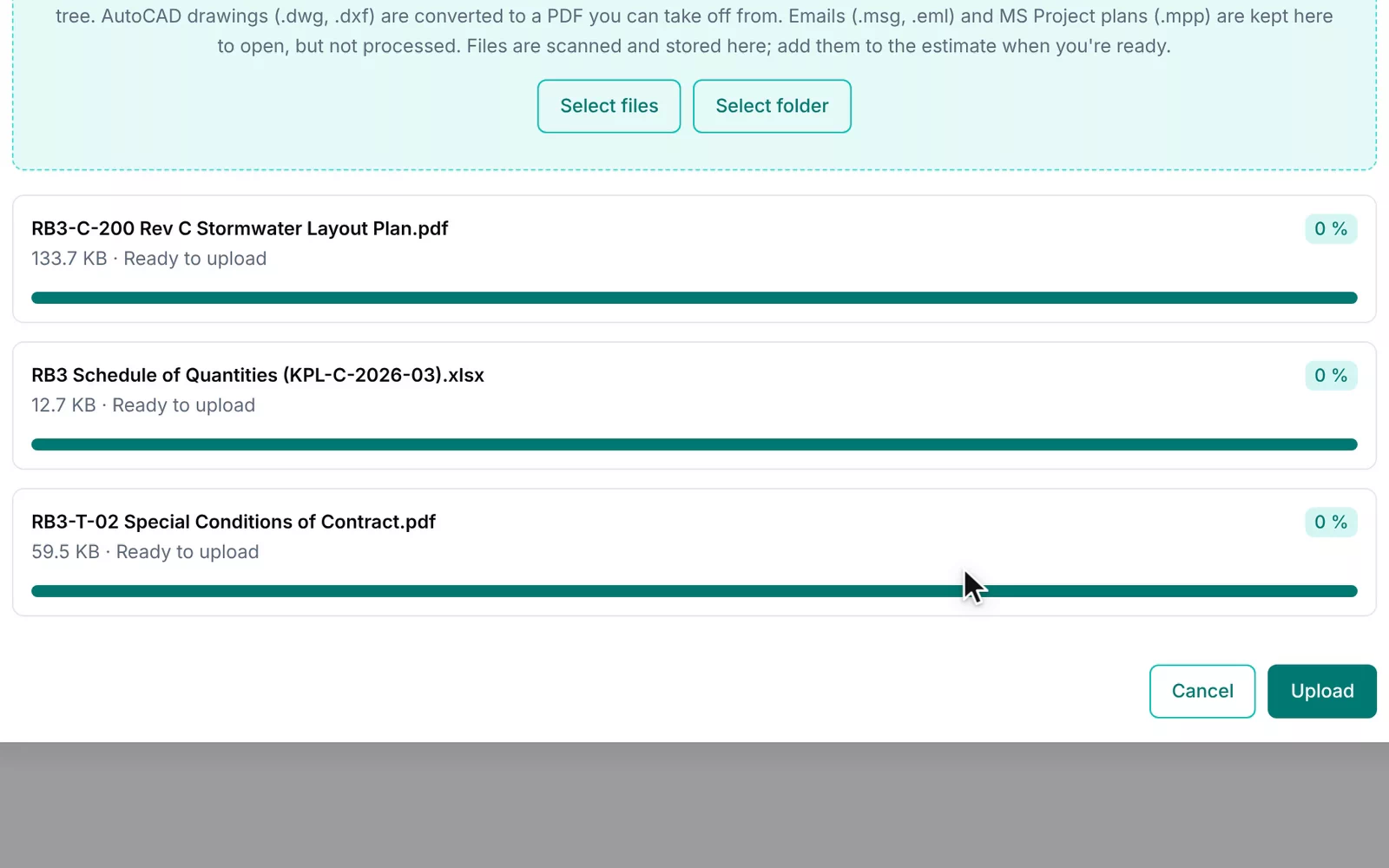
  • Tender in: the client’s schedule is read from the tender pack with its numbering kept, so 3.01 stays 3.01.
  • On the map: council pipes on your map. The council’s pipes and the property boundaries on LINZ aerial or Google Maps, where the job connects.
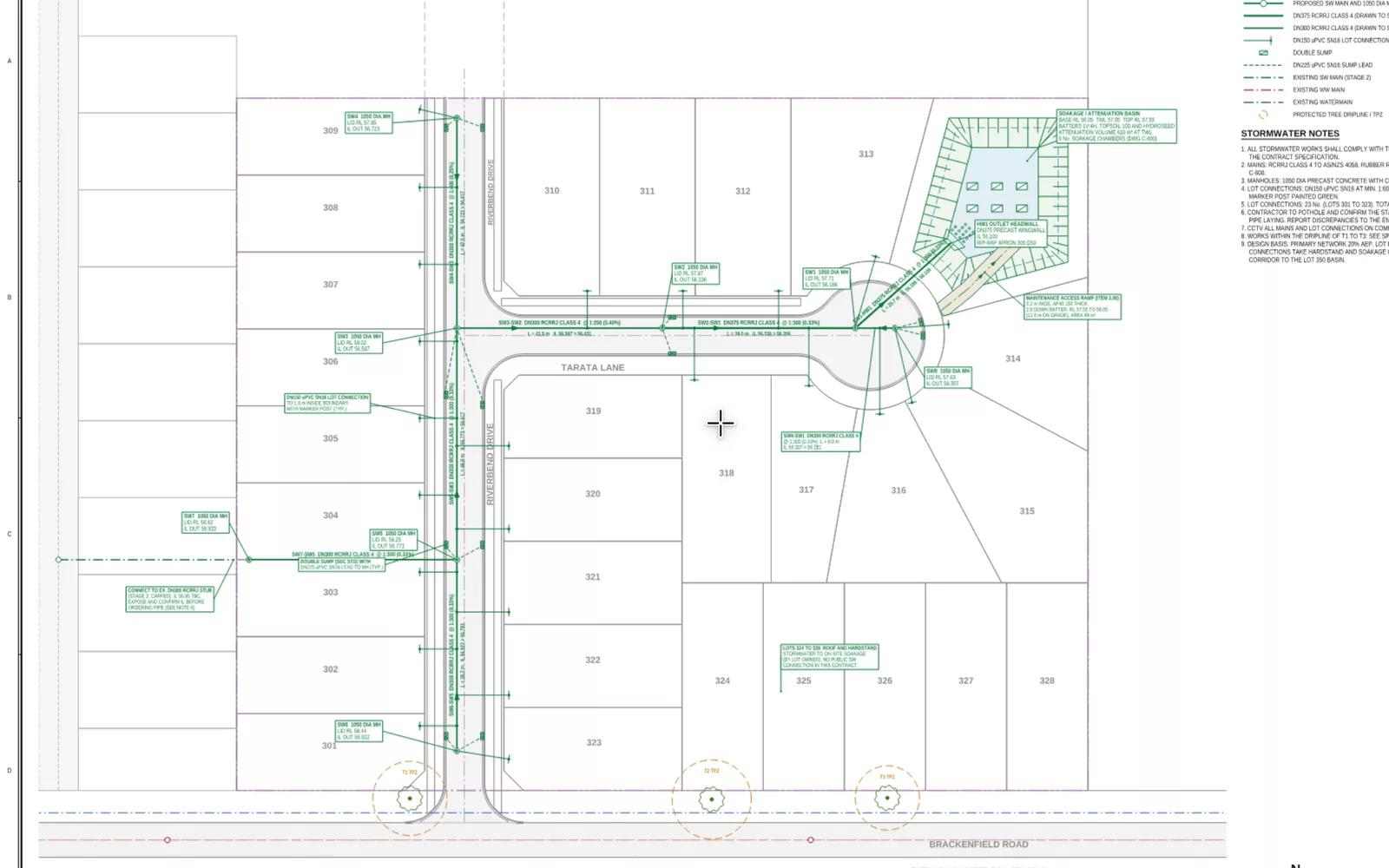
  • Measure: the runs are taken off on the drawing, 219.50 m measured against 220 m scheduled.
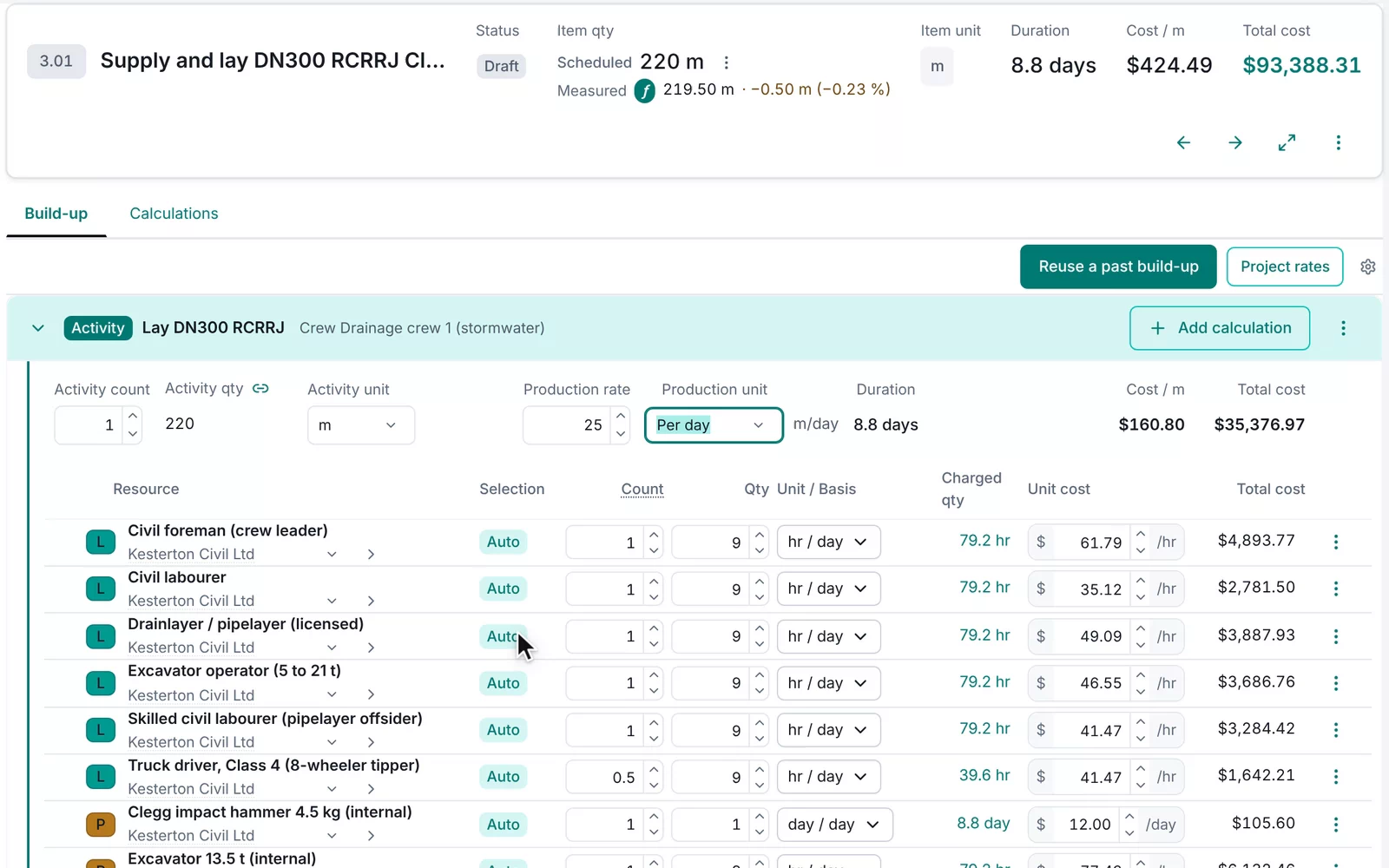
  • Price: suppliers near the job, by road. The trench works out 141.75 m³ of excavation, the crew lays 30 m a day for 7.33 days, and it costs $397.69 a metre to lay.
  • Check and send: a tender review that quotes the tender documents, here the page a finding came from, then their Excel, back priced: 3.01 at $439.96 a metre, $96,791.20.
  • Plan it: the item lands on the tender programme, and the plant pool shows two 5.5 t excavators to hire.
A tender review that quotes the tender documents. Then their Excel, back priced. Animation of Stralos, simplified. Example job. Recorded clips below.

Measure it off the drawing. Price it with your own labour and plant rates, and suppliers and subcontractors ranked by road distance from the job. Send it back in the client’s own Excel. Then programme the job from your price.Measure, price and send their Excel back priced.

Start free on your next tender

Free on Starter: everything in Standard for one person, with up to 5 active projects and 2 AI reviews a month. No card. When you add people or go past 5 active projects, Standard is NZ$199 per user per month + GST. Lite, for quotes, is NZ$99 + GST.

One job, start to finish

Riverbend Stage 3: 28 lots, civil works, with two weeks to close. Priced the usual way, the run is measured off the drawing, the dig is worked out in a trench spreadsheet, and the rate is typed into the client’s schedule and the days into the programme. Every retype is a chance to get it wrong. Below is the same job priced in Stralos, with nothing typed twice.

Loops recorded in Stralos. Example company, job and rates.

1. The tender lands.

Drop in the tender pack. Stralos reads the client’s schedule and suggests the items with their numbering kept exactly, so 3.01 stays 3.01. Accept them and the numbering locks.

The tender pack goes in. Their schedule comes back as suggested items with its numbering kept: 3.01 stays 3.01, at 220 m.

Without Stralos: copying 50 lines from their spreadsheet into yours, then checking you didn’t skip one.

The detail
  • Each suggestion shows the page it came from, and nothing goes in until you accept it.
  • Sections are made for you, and a bundled line splits into parts without losing where it came from.
  • Drawings, specs and price lists live in one place with the job.

2. Takeoff and price it.

Start with what’s already in the ground

Find any New Zealand address on LINZ aerial or Google satellite, turn on the property boundaries and the council’s stormwater, wastewater and water pipes, and click a pipe for its size and material. Coverage: more than 25 councils and water providers.

Recorded in Stralos.

Cathedral Square on LINZ aerial. Property boundaries and the council’s pipes, then one water main’s size and material.

Their schedule says 220 m of DN300. It doesn’t give you the trench. Take off the runs to check their quantities and catch where they’re short, like 3.07, then set up the trench once and it works out what comes out of the ground, what goes back in and what gets carted away. Set the crew and its production rate, and the hours, days and cost per metre follow. Save the activity to your library, with its crew, plant and materials, and use it on the next job. Each time it’s added, Stralos picks the labour, plant and material rates from your rate rules and the job’s location, so nobody looks rates up by hand.

Without Stralos: measuring in one window, typing it into another, a trench spreadsheet only one person understands, and production rates hiding in a formula nobody checks.

Taking off the DN300 runs. The length adds up as you click along the drawing.

Calculators linked to your takeoff and pricing

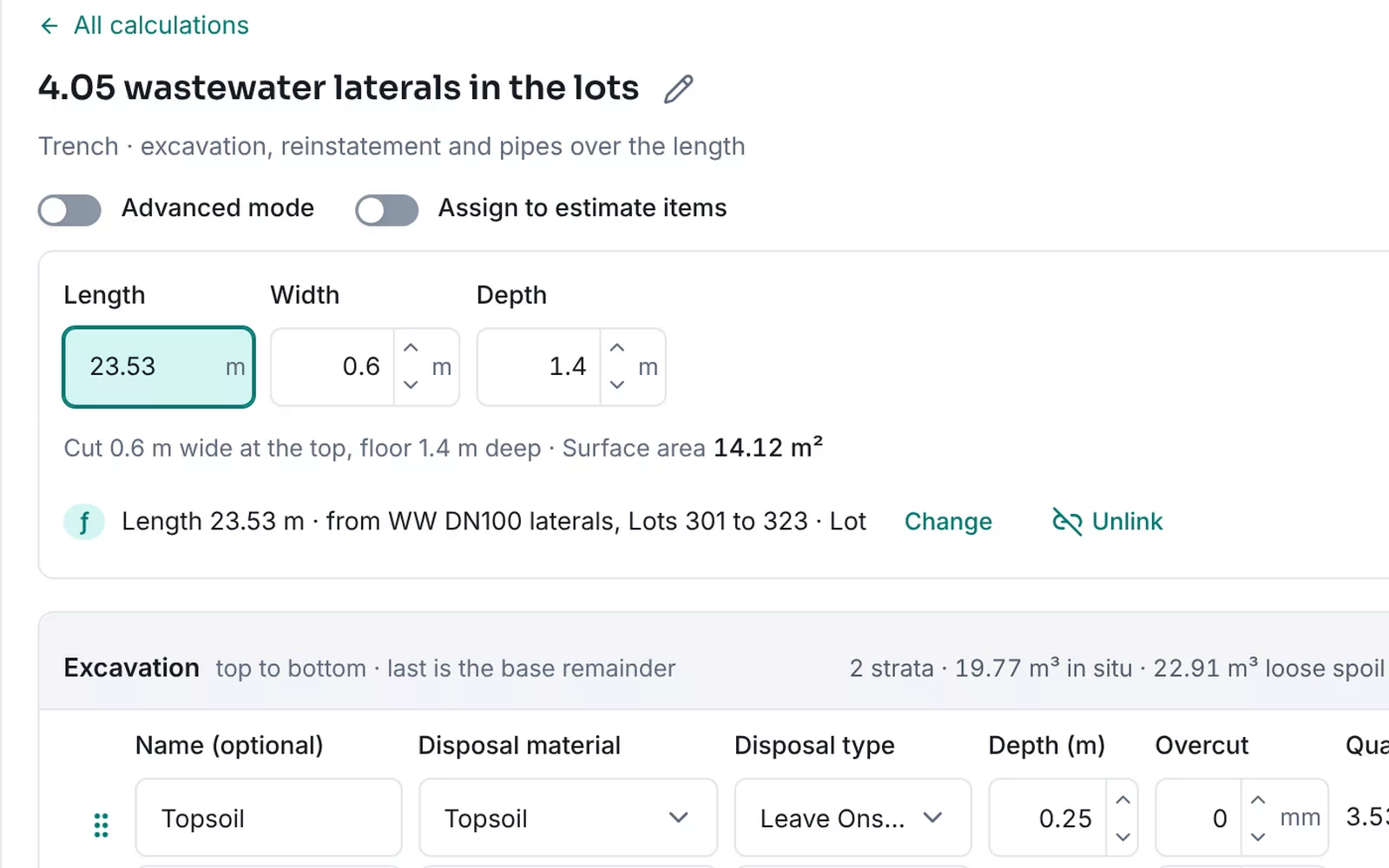
The length comes straight from your takeoff, and the quantities go straight into the item’s price, so nothing is typed twice. It works out ground layers, bedding with the pipe or structure netted out, backfill from the dig, and what’s carted away. Turn it in 3D.

The 4.05 lateral trench. Topsoil and gravel reused, the surplus carted away, then the trench turned in 3D.
Change the production rate. From 25 to 30 m a day, and the duration, hours and cost per metre update. Pricing nights? Add a Night rate beside the standard one and pick it on the lines that need it, and the cost per metre updates.
The detail
  • The trench can take its length straight from the takeoff.
  • Connecting to an existing main? Measure it on LINZ aerial or Google satellite, straight off the council’s pipe records, with the property boundaries on.
  • Each layer of ground has its own bulking, and the bedding allows for the room the pipe or structure takes up.
  • Move a point, change the depth or swap the pipe, and every quantity that depends on it follows.
  • Prices fill from your suppliers and subcontractors within the distance you set, measured by road, and on a Tender job your supplier sites are ranked by road distance and drive time.
  • Price pipe by the length and Stralos charges whole stock lengths for each run.
  • Drop in a supplier’s price list and Stralos matches it to your library. You check each match before anything changes.
Stralos's Closest quarry suppliers panel for Riverbend: Waimakariri Aggregates at 11.7 km and 13 minutes, cheapest overall; Kānuka Aggregates at 12.2 km, cheapest for AP20; Pūhā Shingle at 27.4 km, cheapest for AP65.
Quarries near the job, by road. The closest suppliers by road, with drive time, which materials each is cheapest for, and what their materials would cost on this job.
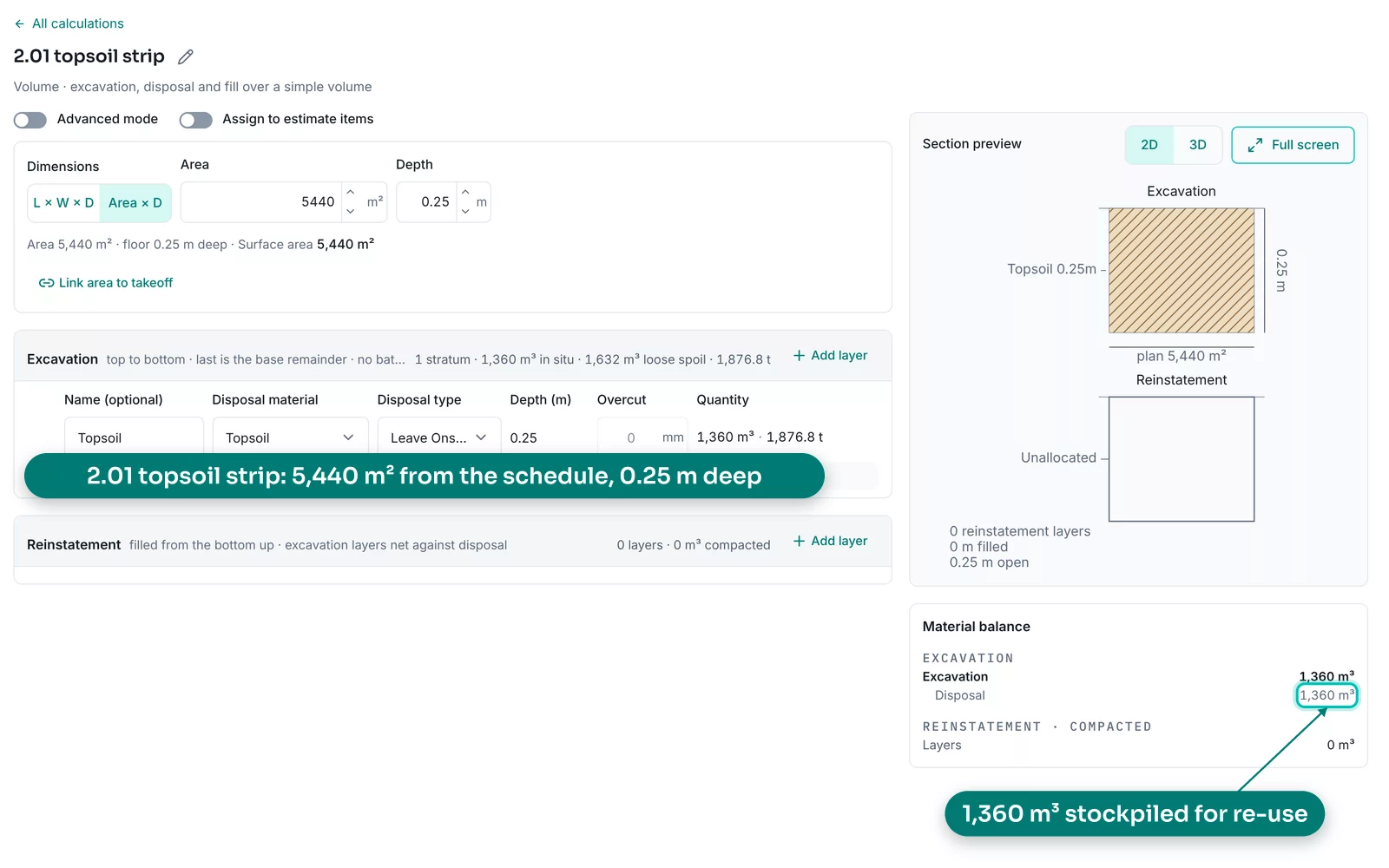
The Volume calculator: 2.01 topsoil strip, 5,440 m² at 0.25 m deep, 1,360 m³.

3. Check it with AI before sending your tender or quote back to the client.

Before it goes, the tender review checks scope gaps, clauses and conditions, quantities against your takeoff and, once you’ve priced tenders in Stralos, pricing against your own recent ones. Findings from the documents quote the page. Then their schedule goes back in their own Excel, priced.

What the tender review goes through

  1. Reads your tender documents and drawings
  2. Gathers your estimate and your recent tenders
  3. Checks scope, clauses, pricing and quantities
  4. Checks each finding’s quoted passage against the page it came from

Usually 2 to 5 minutes.

Without Stralos: finding the tree clause at the pre-start meeting.

The detail
  • Quantities against your takeoff catch 3.07: the lot connections the schedule calls 201 m and your takeoff measures at 223.7 m, ready to query before questions close.
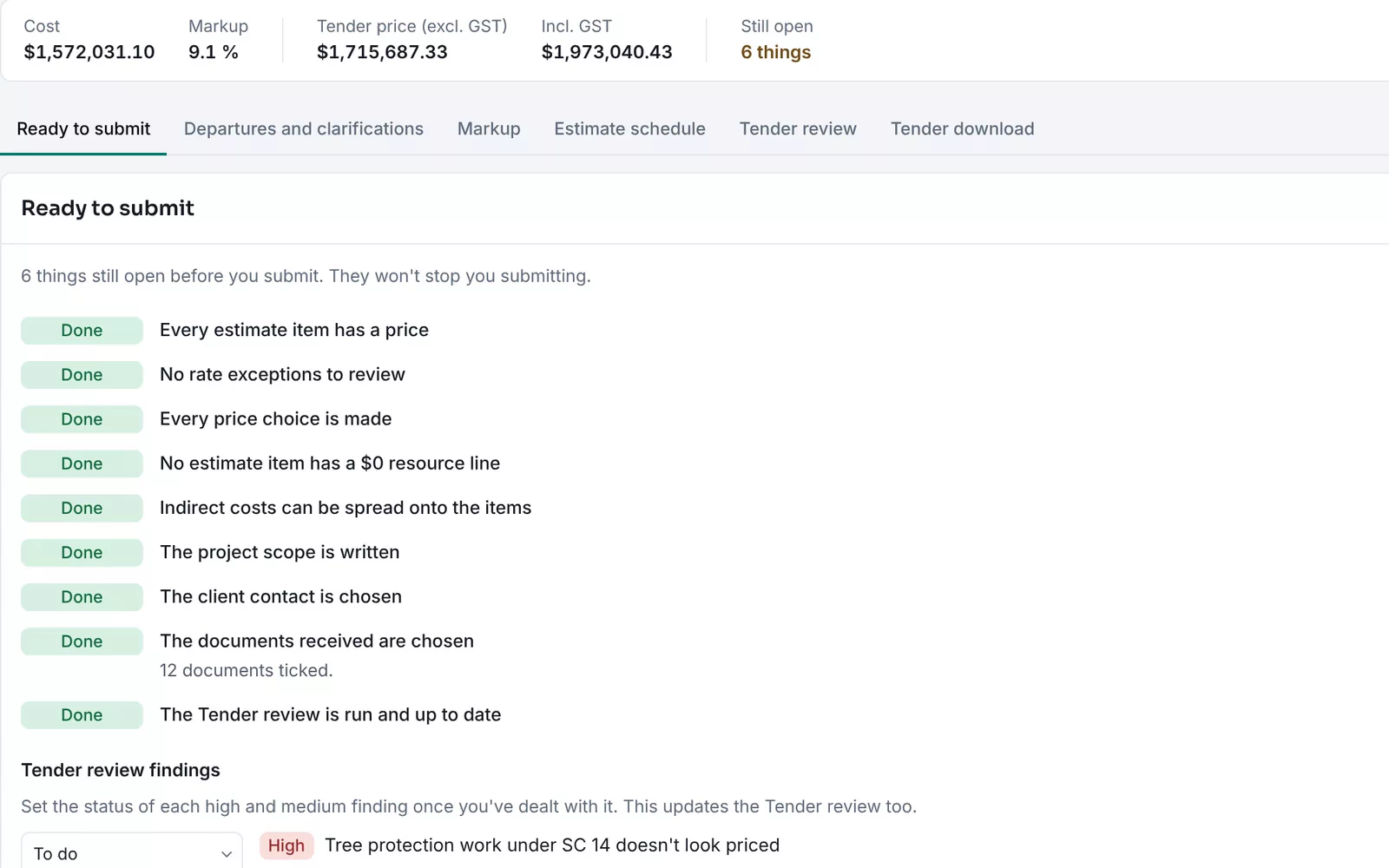
  • Ready to submit lists what’s still open: unpriced items, $0 lines and rate exceptions.
  • Their schedule goes back in their own Excel with the numbering untouched, alongside a branded PDF.
  • Send each person their own private link, and Stralos tells you the first time they open it. The revision you sent is kept exactly as sent.
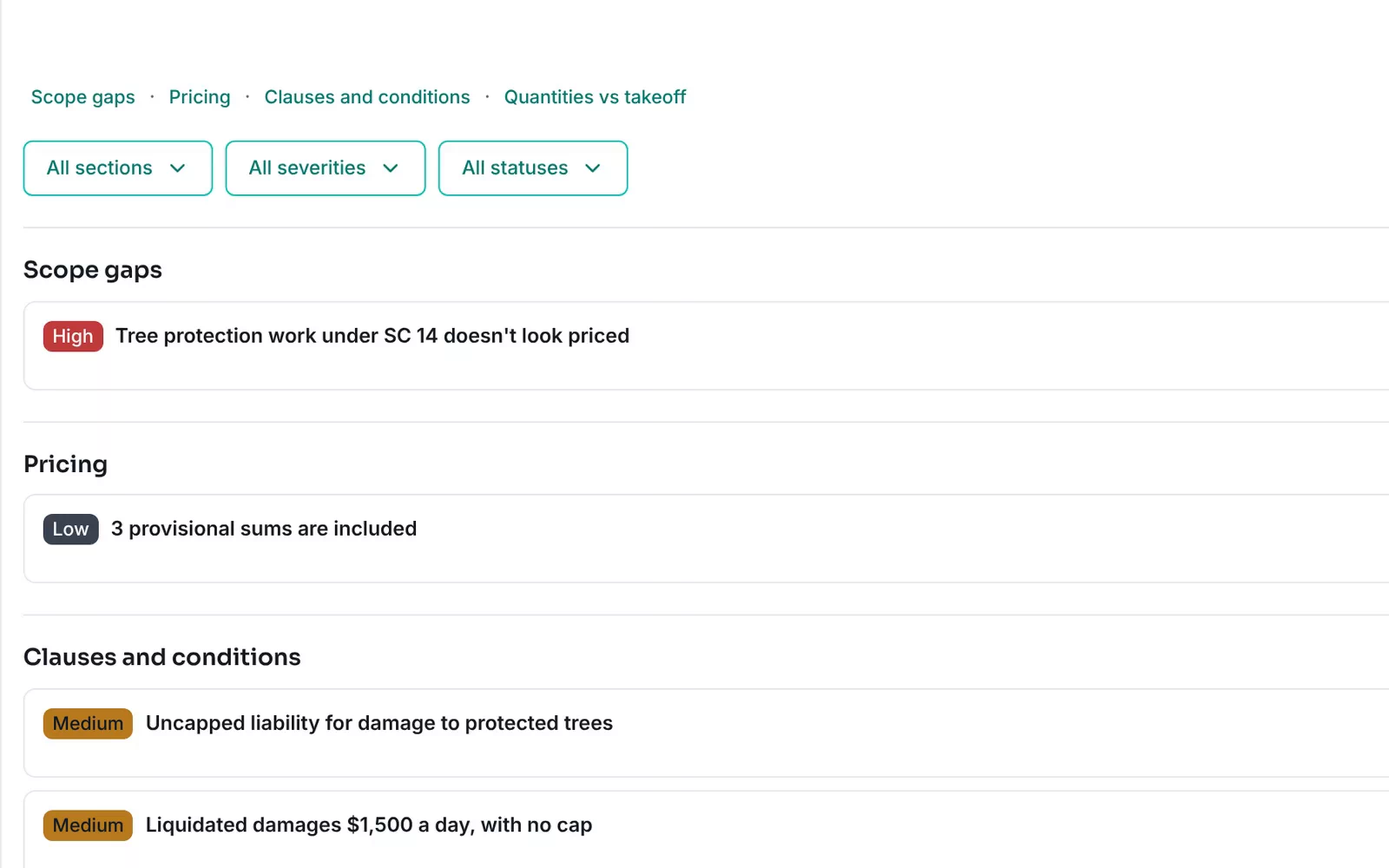
The tender review’s findings. Tree protection under SC 14, uncapped liquidated damages and aggregate prices that expire, each citing the page it came from.
Ready to submit. What’s done and what’s open, the download as PDF, Excel or Word, their own workbook priced, and a private link for one person.

What it catches

  • Scope gaps

    Work the documents ask for that isn’t priced

    Like tree protection buried in the special conditions, found before the pre-start, not after.

  • Quantities

    Their quantity doesn’t match your takeoff

    201 m scheduled, 223.7 m measured. Query it before questions close.

  • Clauses and conditions

    Liquidated damages, insurance and one-sided clauses

    Spotted while you can still price the risk or qualify it.

  • Clauses and conditions

    Supplier prices that run out before the work’s done

    Like an aggregate price list that ends partway through the job. Spotted while you can still get a project quote.

  • Pricing

    Trucks that can’t move the material

    Truck hours well short of the spoil and metal you’ve priced, or plant charged twice.

  • Pricing

    Prices that stand out from your recent tenders

    Markup and rates checked against your own past jobs, once you’ve priced a few in Stralos.

Ask Doug about your estimate

Example answers

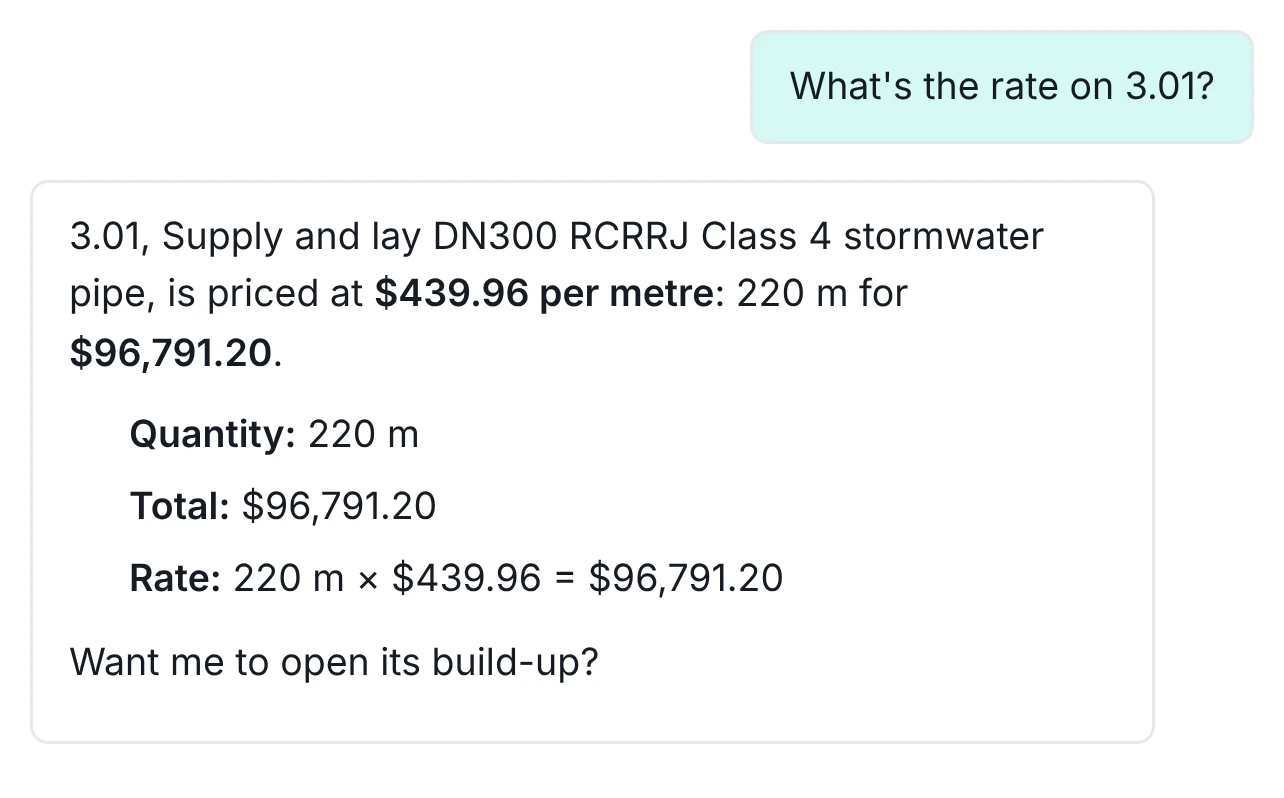
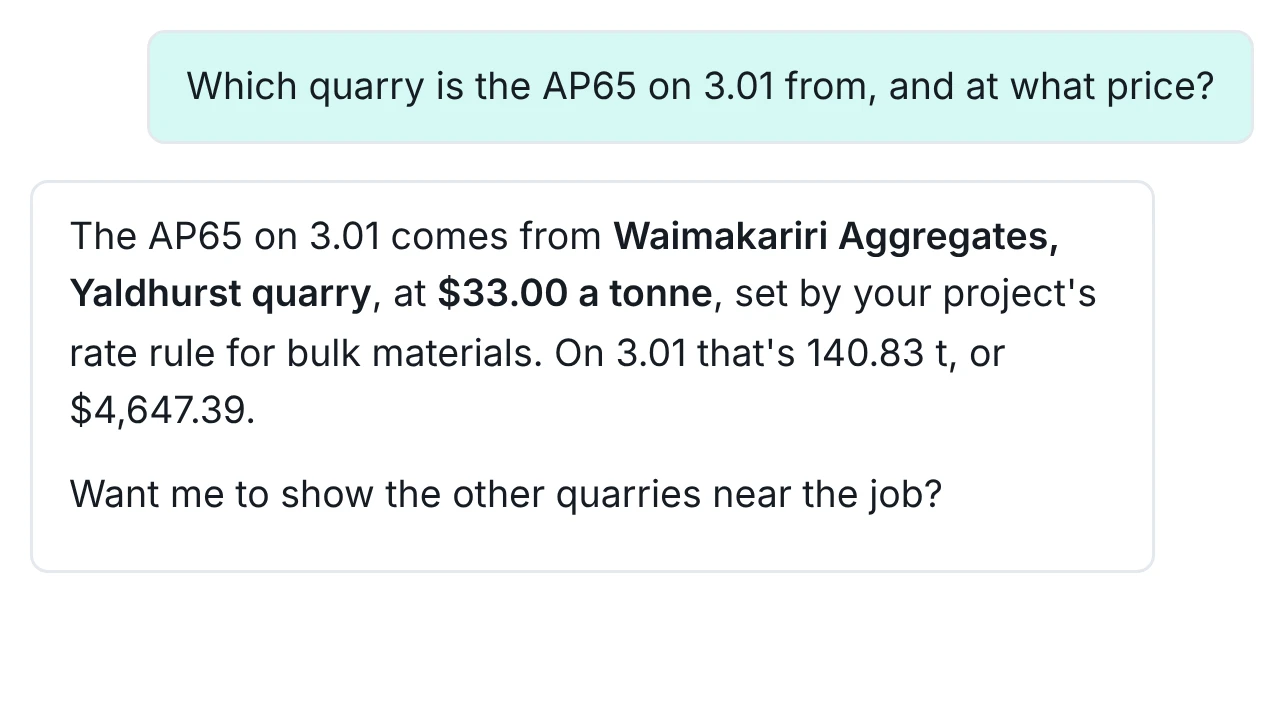
Doug, asked “What’s the rate on 3.01?”, answers that 3.01, supply and lay DN300 RCRRJ Class 4 stormwater pipe, is priced at $439.96 per metre: 220 m for $96,791.20.
Doug, asked “Which quarry is the AP65 on 3.01 from, and at what price?”, answers Waimakariri Aggregates, Yaldhurst quarry, at $33.00 a tonne, set by the project’s rate rule for bulk materials: 140.83 t on 3.01, or $4,647.39.

Doug can get things wrong, so check anything important.

Start free on your next tender

Free on Starter: everything in Standard for one person, with up to 5 active projects and 2 AI reviews a month. No card. When you add people or go past 5 active projects, Standard is NZ$199 per user per month + GST. Lite, for quotes, is NZ$99 + GST.

4. Win it, then plan it.

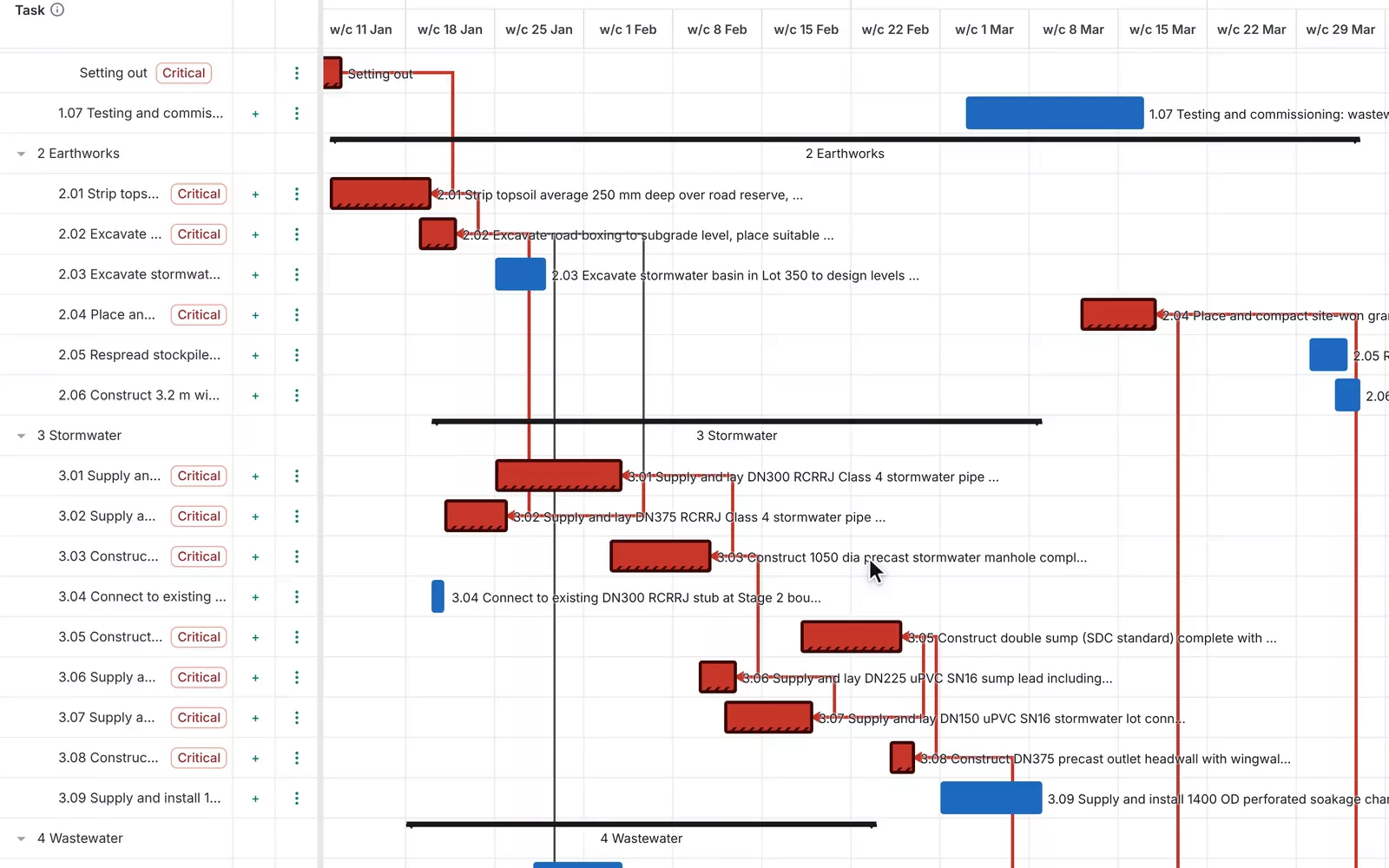
Every item lands on the tender programme, with bar lengths from your crews’ production rates, brought up to date in one click. Pencil in the jobs you’re still pricing to see what you’d need to hire. Win one, turn it into the project programme and book your crews, people and plant against it.

Programme and the scheduler are being released to all companies shortly.

The tender programme. Bars from your crews’ production rates, then the scheduler’s week with crews, plant and a Hire 2 flag.

Without Stralos: rebuilding the programme from scratch the week you win.

The detail
  • On the project programme, the critical path shows in red, and the whole programme, people and plant included, exports to MS Project.
  • When bookings outstrip your fleet, the plant pool shows how many you’ll need to hire.
Start free on your next tender

Free on Starter: everything in Standard for one person, with up to 5 active projects and 2 AI reviews a month. No card. When you add people or go past 5 active projects, Standard is NZ$199 per user per month + GST. Lite, for quotes, is NZ$99 + GST.

Built by people who price and build the work

James and Ben run a civil, utilities and traffic management contractor working across Canterbury and Central Otago, and price its tenders in Stralos. Mike and Graeme are experienced software developers who build it, so Stralos comes from people who price the work and people who build software.

  • James Macdonald

    Founder

    James is CEO of Atlas Group, a civil, utilities and traffic management contractor operating across Canterbury and Central Otago. His experience spans business leadership, forecasting and construction operations, bringing a contractor’s perspective to Stralos and the challenge of keeping estimates, project delivery and financial performance connected.

  • Ben Hopewell

    Founder

    Ben is General Manager of Atlas Group, overseeing its civil, utilities and traffic management operations. He previously held regional management roles at a national civil company and led an ASX-listed company. He brings practical experience coordinating people, plant and projects, helping shape Stralos around the everyday needs of construction teams.

  • Mike Ryan

    Founder

    Mike has spent his career turning complex business requirements into software and reporting people actually use. He spent more than a decade at Vault and then Damstra Technology in customer support and reporting, then nearly five years at a business intelligence consultancy. Alongside that he founded RapidCert, a contractor prequalification platform, which he built with Graeme, and he runs Ryan Analytics and a software and web development business.

  • Graeme Ainsworth

    Founder

    Graeme has spent more than 25 years building software for industries where getting it right matters. He spent 14 years at Vault as CTO, growing it into a health and safety platform used by NZX and ASX listed companies and 100+ councils. He went on to be CTO at Herd-i, using AI to spot health problems in dairy herds, and then built and launched RapidCert with Mike, a contractor prequalification platform.

Start free, then Standard for tenders or Lite for quotes

Starter

Free for one person, with no card and no time limit

Not sure Stralos is right for you? Price a real job on Starter, free with no time limit.

  • Everything in Standard: takeoff, calculators, your rates and price lists, quotes and tenders, the client’s schedule and workbook, Tender review and Schedule review, and Doug.
  • Up to 5 active projects at a time, and 2 AI reviews a month. No contractor guests.
  • Move to Lite or Standard any time in Settings, Billing. Everything you’ve set up stays as it is.

Lite

NZ$99 per user per month + GST

Or pay yearly: NZ$990 per user per year + GST. That’s 10 months’ price for 12. The whole year is charged when you choose it.

In Australia: AU$99 per user per month, or AU$990 per user per year, no GST charged. Elsewhere: US$79 per user per month, or US$790 per user per year.

For smaller jobs and dayworks, priced from your own costs.

  • Quotes and estimates, with up to 10 priced lines a quote. Tendering isn’t on Lite.
  • Pricing from your own crew, plant and material costs, rate libraries, takeoff and calculators, share links, approvals and the AI quote review.
  • Choose Lite in Settings, Billing when you’re ready.

Standard

NZ$199 per user per month + GST

Or pay yearly: NZ$1,990 per user per year + GST. That’s 10 months’ price for 12. The whole year is charged when you choose it.

In Australia: AU$199 per user per month, or AU$1,990 per user per year, no GST charged. Elsewhere: US$149 per user per month, or US$1,490 per user per year.

Less than a day of an estimator’s pay each month.

  • Includes takeoff and calculators, rates from your own crews and plant, rate libraries, schedule and tender review, tender output and Doug, the built-in assistant. Programme and the scheduler are included too, and are being released to all companies shortly.
  • You pay for each person with a Stralos login, not for the crews, workers and machines you schedule.
  • Choose Standard in Settings, Billing when you’re ready. Cancel any time.
  • Short on time? Ask us and we’ll load your price list into your rate library for you.

Putting the whole company on Stralos? Enterprise adds single sign-on, custom SLAs and invoicing, set up with you.

What’s next

Today Stralos covers winning the work and planning it. Next come running the job, getting paid and your accounts.

Being designed with a Canterbury and Otago contractor’s site and office teams.

  1. Run it

    In the order contractors ask for them

    • Field team access, so the crew on site works from the same job.
    • Time tracking and job costing as the job runs.
    • QA tracking, kept with the job.
  2. Get paid

    In the order contractors ask for them

    • Variations, with the messages about each one kept together.
    • A variation check before it goes to the client.
    • Progress claims from the same job.
  3. Accounts

    In the order contractors ask for them

    • Connections to Xero and MYOB.
    • So jobs and claims don’t get typed into your accounts again.
Start free on your next tender

Free on Starter: everything in Standard for one person, with up to 5 active projects and 2 AI reviews a month. No card. When you add people or go past 5 active projects, Standard is NZ$199 per user per month + GST. Lite, for quotes, is NZ$99 + GST.

Not pricing a tender right now? Tell us what you’d use first.

What you’d use first

Questions

Will it handle how we price our work?

Rates worked out from your own crews, plant, materials, subcontractors and disposal; production rates; material and structure calculators linked to your takeoff and pricing; NZS 3910, 3915, 3916, 3917, NZIA, Master Builders, Certified Builders, NEC and FIDIC tenders, with the on-site and off-site overhead percentages set per project.

Does it work with the client’s Excel schedule?

Yes: import it with their numbering locked, then export your rates back into their own workbook. (Each item needs to match one row of their sheet. Split items roll back into their parent’s row.)

Can I bring my rates and supplier price lists?

Drop in Excel, CSV or PDF price lists; Stralos matches each line to your library and you check each match before anything changes. Labour and plant rates go in once and are reused on every job.

What drawings can I measure on?

PDF drawings. A multi-page drawing set is stitched into one whole-site drawing, so a run across match lines is one measurement, and the scale is read from the sheet and checked, or worked out from a dimension you know. With no drawing, measure on LINZ aerial or Google Maps map sheets, with council pipe layers where they’re available (not yet Dunedin, Invercargill or Auckland stormwater).

How long until my first priced item?

Your company starts empty, so bring a supplier price list and your labour and plant rates, or ask us to load your price list for you. Allow 30 to 45 minutes to a first priced item.

I’m an owner-operator. Is it overkill?

No. Start on Starter: it’s free for one person, with up to 5 active projects at a time. When you need more, Lite and Standard are priced per user, so one seat is all you pay for. Use the parts you need.

Is Stralos ready for a live tender?

Estimating, tender review and output are live and used on a working contractor’s own tenders. The programme and the scheduler are being released to all companies shortly. Things will keep improving. Move to Standard and everything you set up stays as it is. Lite is for quotes, so Tender jobs become read-only there.

What’s coming, and when?

Next come running the job (field team access, time tracking, job costing and QA tracking), getting paid (variations, a variation check and progress claims) and Xero and MYOB. They’re being designed with a Canterbury and Otago contractor’s site and office teams and will come in the order contractors ask for them. There are no dates yet. See what’s next.

Is there an AI assistant?

Yes. Doug, the assistant built into Stralos, can find things in the app for you and propose changes as cards you check and accept. He can’t delete anything. He’s still learning, so check anything important.

Who can see our rates, and where’s our data?

The people you invite see your company’s data. Stralos staff only see it when you ask us to, for security, or when the law requires it, and each time is logged. It’s stored with Amazon Web Services in Sydney. AI features use providers whose terms don’t let them train on your data.

Can I get my work out if I stop?

Tenders download as PDF, Excel or Word, and the client’s schedule exports back into their own workbook.

What’s free on Starter?

Everything in Standard, for one person, with no card and no time limit. Up to 5 projects can be active at a time: mark one completed, lost or archived to start another. A project marked completed, lost or archived can’t be reopened while you’re on Starter. You get 2 AI reviews a month, and you can still send your tender or quote without one. To add your team, or for more projects and reviews, or to invite contractor guests, choose Lite or Standard in Settings, Billing.

Who counts as a user?

Each person in your company with access to Stralos, including people you’ve invited who haven’t signed in yet.

Can I cancel?

Yes, at any time, in the app or by getting in touch. Cancelling takes effect at the end of the month or year you’ve paid for, and you can keep using Stralos until then. The rest of the month or year isn’t refunded.

Can I pay yearly?

Yes. A yearly plan is NZ$1,990 per user per year + GST on Standard, or NZ$990 + GST on Lite, paid up front: 10 months’ price for 12. The whole year is charged on the day you choose yearly. You can move from monthly to yearly at any time, and the unused part of your month is credited. Moving back to monthly happens at your yearly renewal. Users you add during the year are charged for the rest of the year straight away; users you remove come off at renewal.

Start free on your next tender

Free on Starter: everything in Standard for one person, with up to 5 active projects and 2 AI reviews a month. No card. When you add people or go past 5 active projects, Standard is NZ$199 per user per month + GST. Lite, for quotes, is NZ$99 + GST.

Checking sign-ups…

Start free on your next tender

Start free on your next tender

Free on Starter: everything in Standard for one person, with up to 5 active projects and 2 AI reviews a month. No card. When you add people or go past 5 active projects, Standard is NZ$199 per user per month + GST. Lite, for quotes, is NZ$99 + GST.

Request a callback

Leave your number and one of us will ring you within one working day. If you’d like, we’ll show you Stralos on a job like yours while we’re on the call.

We’ll use these details to call you back and follow up afterwards. See our privacy policy.