
Industries
Drainage estimating software for drainlayers: from the drawing to a priced schedule
Stralos is drainage estimating software for drainlayers and civil contractors pricing stormwater, wastewater and water supply: council renewals, subdivision mains and drainage subcontracts. Take off the runs, type in each depth, and the trench calculator works out what comes out, goes back and gets carted. Then build each metre rate from your own crew, plant, pipe and metal.
Free on Starter: everything in Standard for one person, with up to 5 active projects and 2 AI reviews a month. No card. When you add people or go past 5 active projects, Standard is NZ$199 per user per month + GST. Lite, for quotes, is NZ$99 + GST.
What makes drainage hard to price?
-
The schedule pays by the metre. You pay for the dig.
One line reads “Supply and lay DN300 RCRRJ Class 4 stormwater pipe including trench support, AP20 bedding, haunch and surround, and backfill, not exceeding 2.0 m deep”. NZS 4224:1983, the old code for measuring civil quantities, was withdrawn without replacement, so each contract’s schedule notes decide what a metre includes.
-
At 1.5 m the job changes.
Regulation 24 of the Health and Safety in Employment Regulations 1995 wants any face over 1.5 m high shored, so far as is reasonably practicable, unless it’s cut back to a safe slope or another listed exception applies. It’s one reason schedules band by depth, and why the deep metres lay slower.
-
In a road, the reinstatement is wider than the trench.
The national code for work in road corridors (version 3, in force 8 November 2024) sets a trimming allowance of at least 150 mm beyond the original saw cut, and a two-year warranty on the work.
One job, priced in Stralos: 220 m of DN300 stormwater
Example job and company: Riverbend Stage 3, a 28-lot subdivision in Selwyn District, priced by the fictional Kesterton Civil Ltd. This is item 3.01.
-
Bring in the client’s schedule.
Stralos reads it from the tender pack and suggests the items with the client’s numbering kept, so 3.01 stays 3.01 at 220 m. Accept them and the estimate schedule locks to theirs. (On Standard, and free on Starter.)
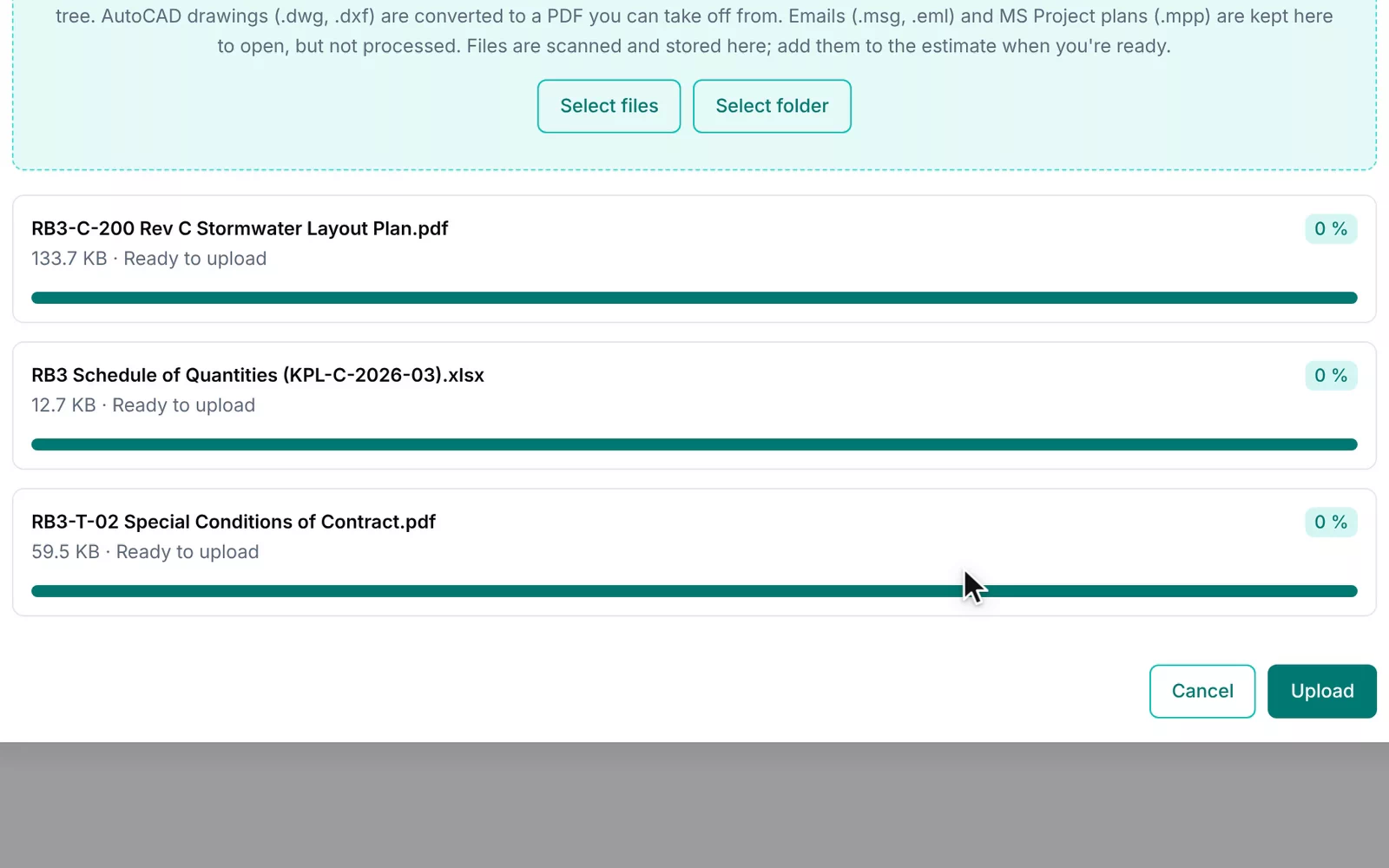
Recorded in Stralos: the tender pack goes in and row 3.01 comes through at 220 m, as the client wrote it. Example job. -
Take off the runs.
Measure the DN300 on the layout plan with Multi-segment, tagging each span: Carriageway 180 m, Berm and easement 39.5 m. That’s 219.50 m against 220 m scheduled. Theirs stays, and yours sits beside it. Connecting to an existing main? Measure it on LINZ aerial or Google Maps satellite from the council’s pipe records: stormwater, wastewater and drinking water from more than 25 councils and water providers, not nationwide.
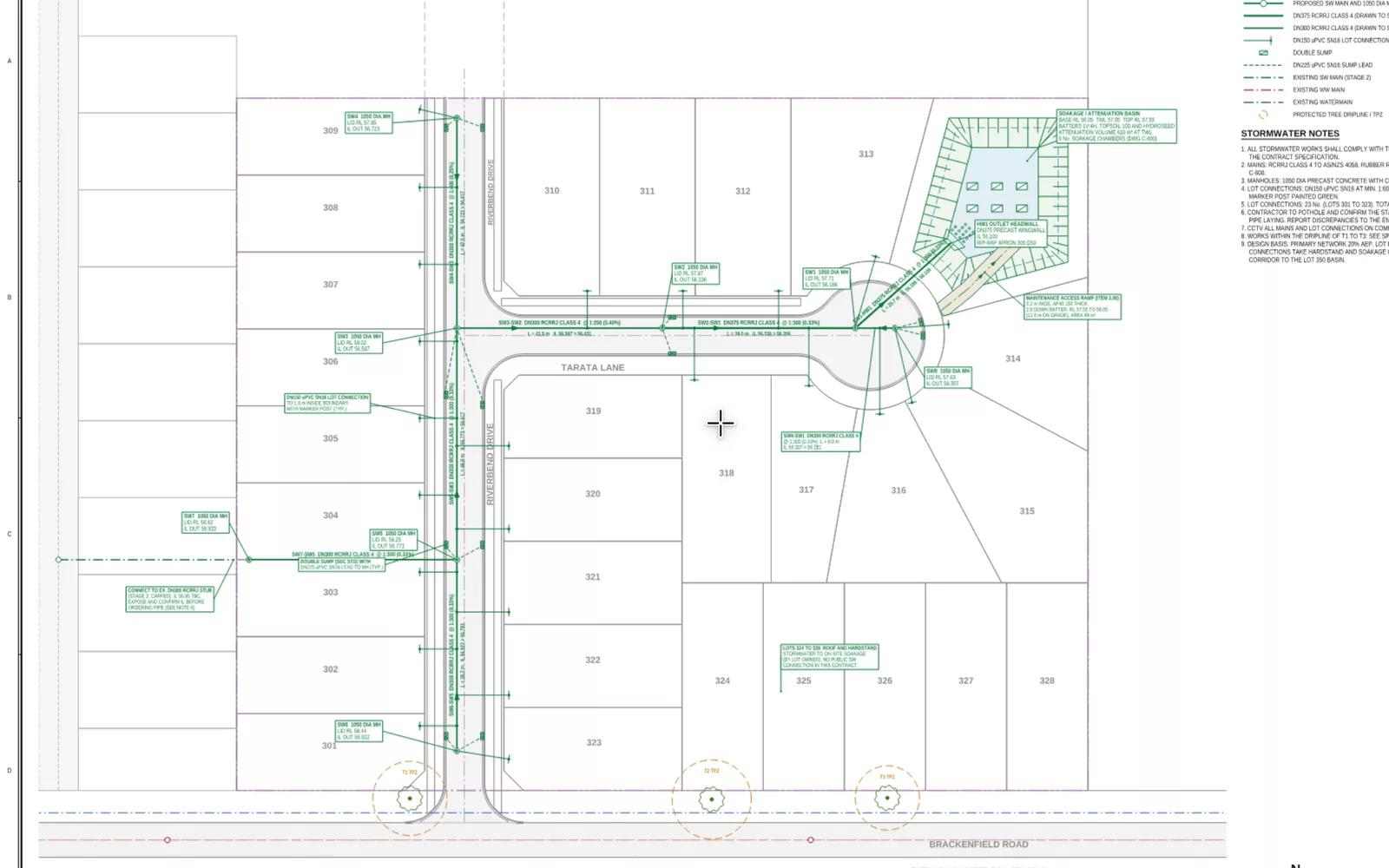
Recorded in Stralos: the DN300 runs taken off on the drawing, 219.50 m measured against 220 m scheduled. Example job. 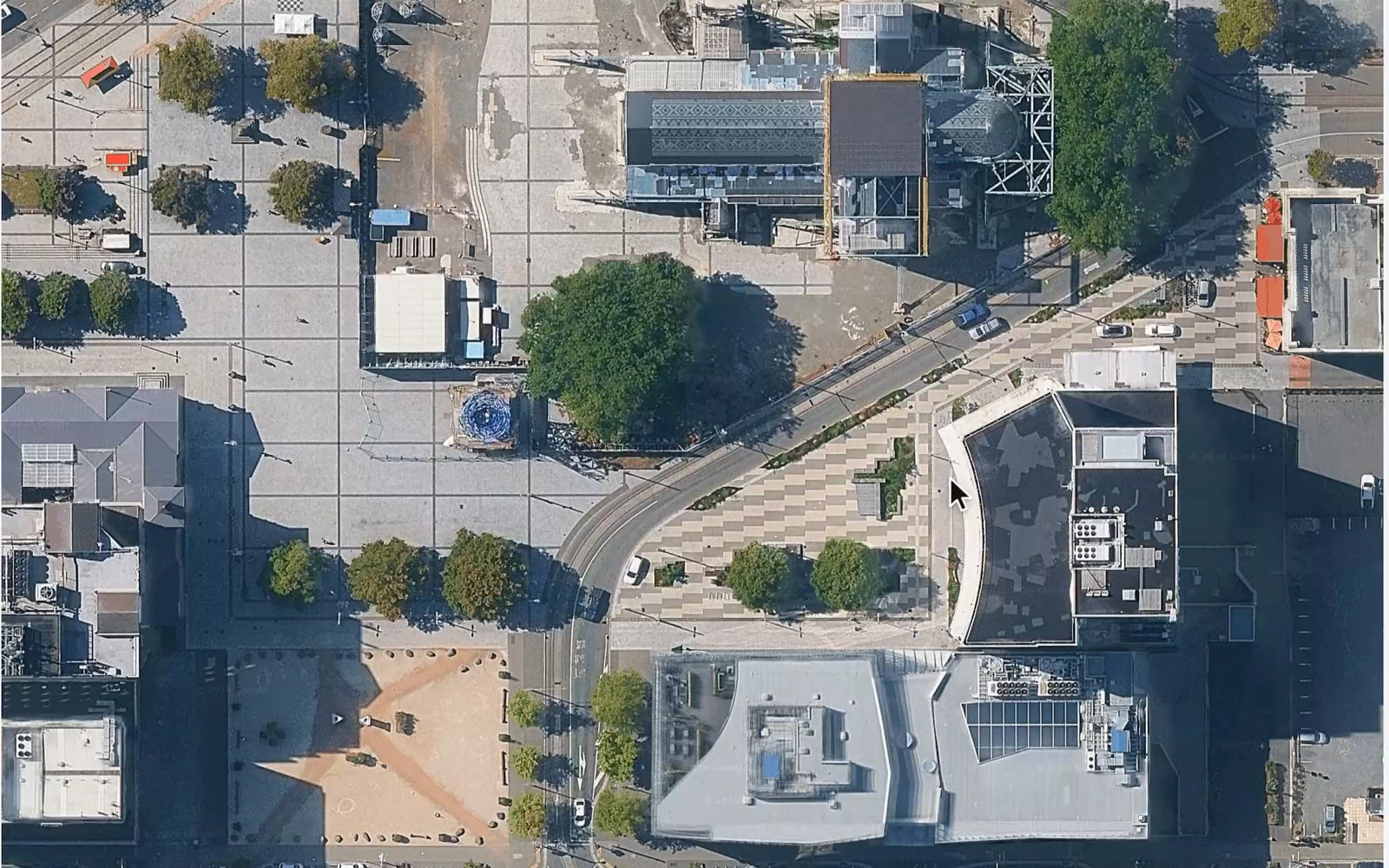
Recorded in Stralos: Cathedral Square, Christchurch, on LINZ aerial with property boundaries and the council’s pipes, then one water main’s details from the council’s records.Aerial imagery and property boundaries: Toitū Te Whenua LINZ, CC BY 4.0. Pipe data: Canterbury Maps and partners, CC BY 4.0. -
Work out the trench.
The trench takes its length from the Carriageway tag. You enter the width your specification calls for and the depth from the long section. 180 m long, 0.75 m wide and averaging 1.05 m deep from subgrade is 141.75 m³ in the ground and 163.01 m³ on the truck at 15% bulking: 277.12 t. AP20 bedding, haunch and surround is 64.32 m³ with the pipe netted out, AP65 backfill 58.19 m³. The berm run is its own trench.
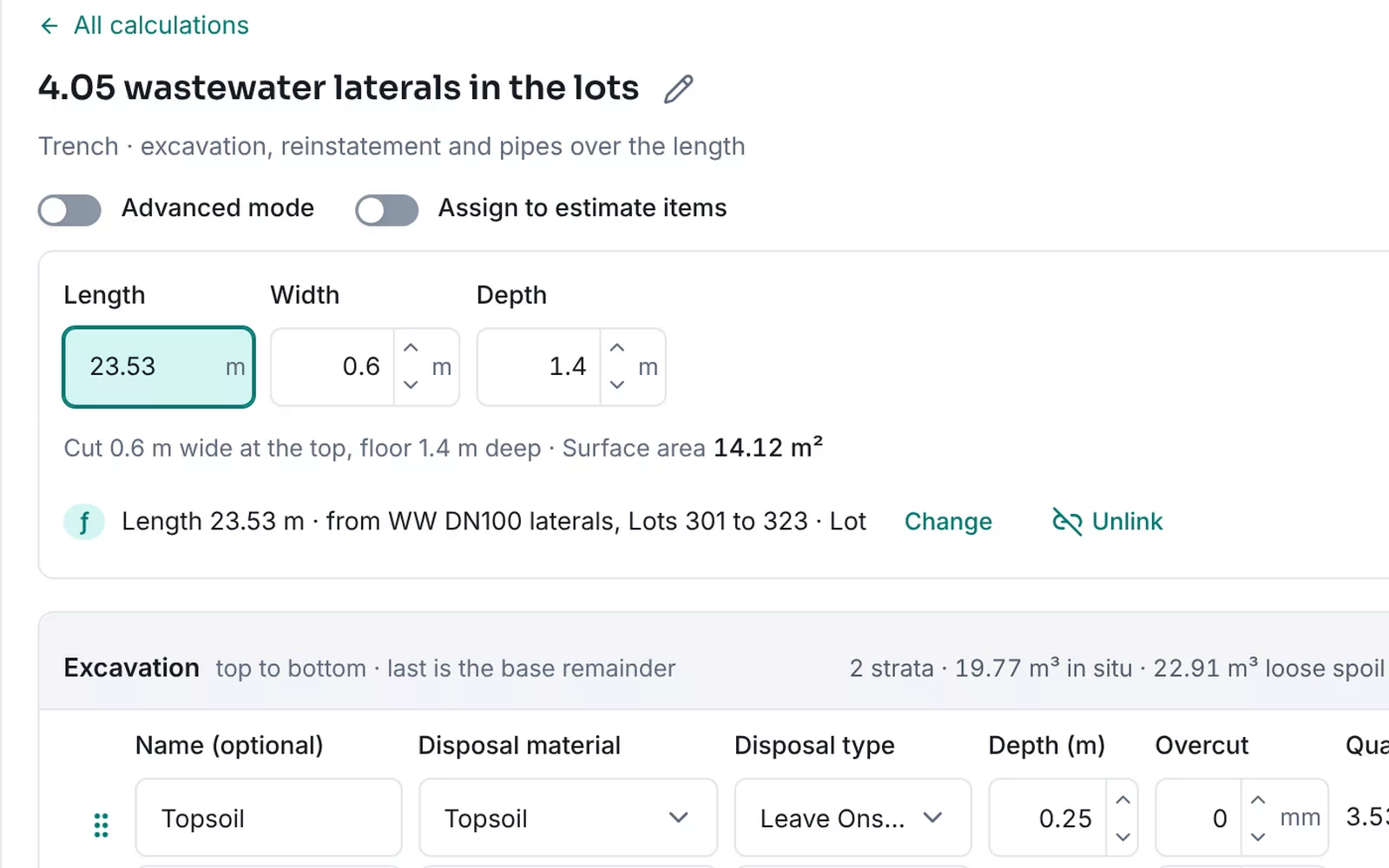
Recorded in Stralos: a lateral trench on the same job, with topsoil and gravel reused, the surplus carted, then the trench turned in 3D. Example job. -
Set the production rate.
At a production rate of 30 m a day, for a crew of five with a 13.5 t and a 5.5 t excavator and a shared tipper, 220 m is 7.33 days of work. Drop to 25 m a day and the cost goes from NZ$397.69 to NZ$424.49 a metre.
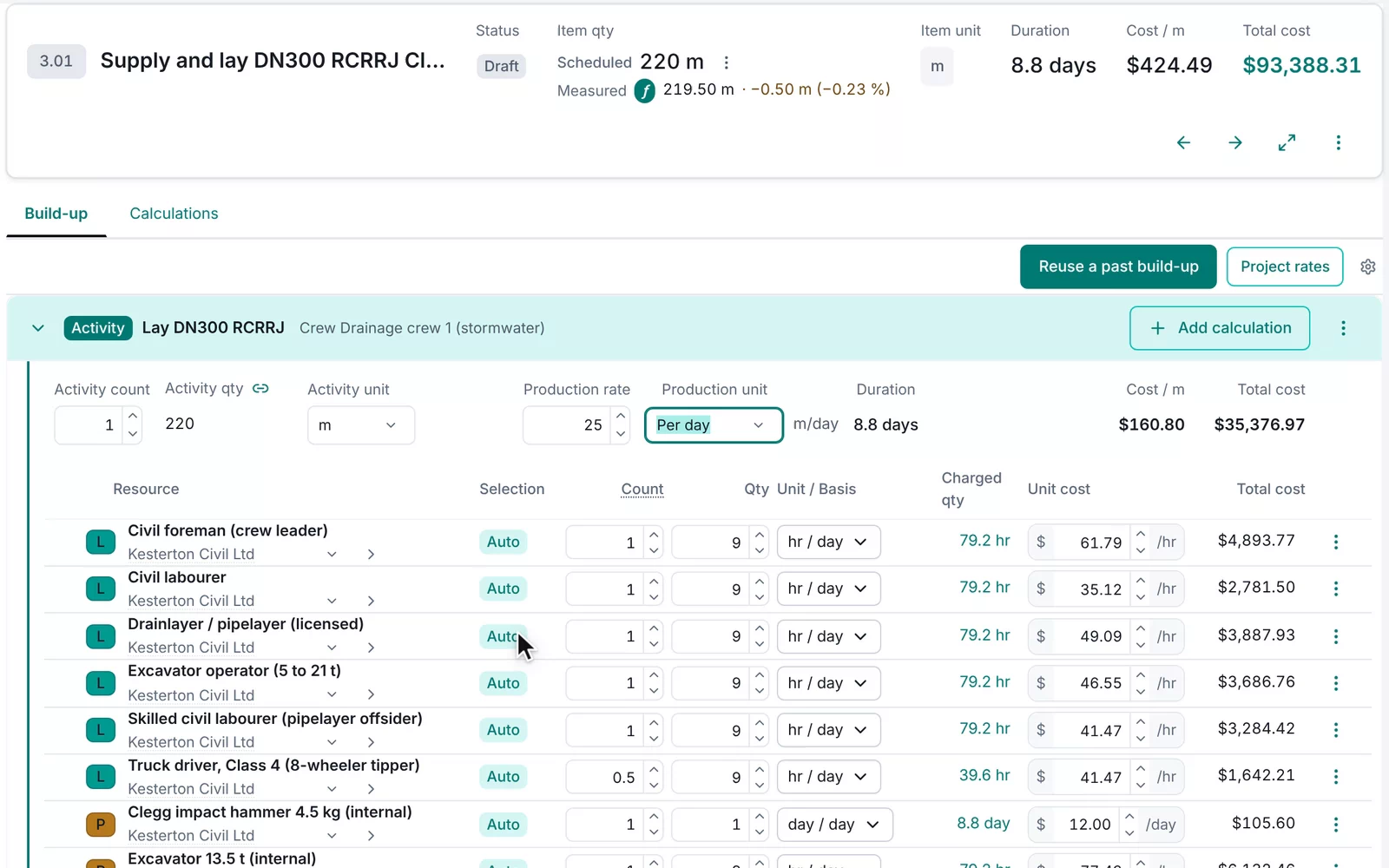
Recorded in Stralos: the production rate changes from 25 to 30 m a day, and the days, hours and cost per metre follow. Example job and rates. -
Price the metal and the pipe.
Up to ten of your closest quarry supplier sites, from the suppliers you’ve loaded, are ranked by road distance, with drive time shown: here the closest is 11.7 km and 13 minutes away. That 58.19 m³ of AP65 (58.185 m³ before rounding) at 2.262 t/m³ compacted, plus 7% for overbreak and wastage, is 140.83 t to buy: NZ$4,647.39 at NZ$33.00 a tonne ex quarry. Cartage is a separate line, NZ$9.80 a tonne here. Pipe priced by the length is ordered in whole lengths for each run.
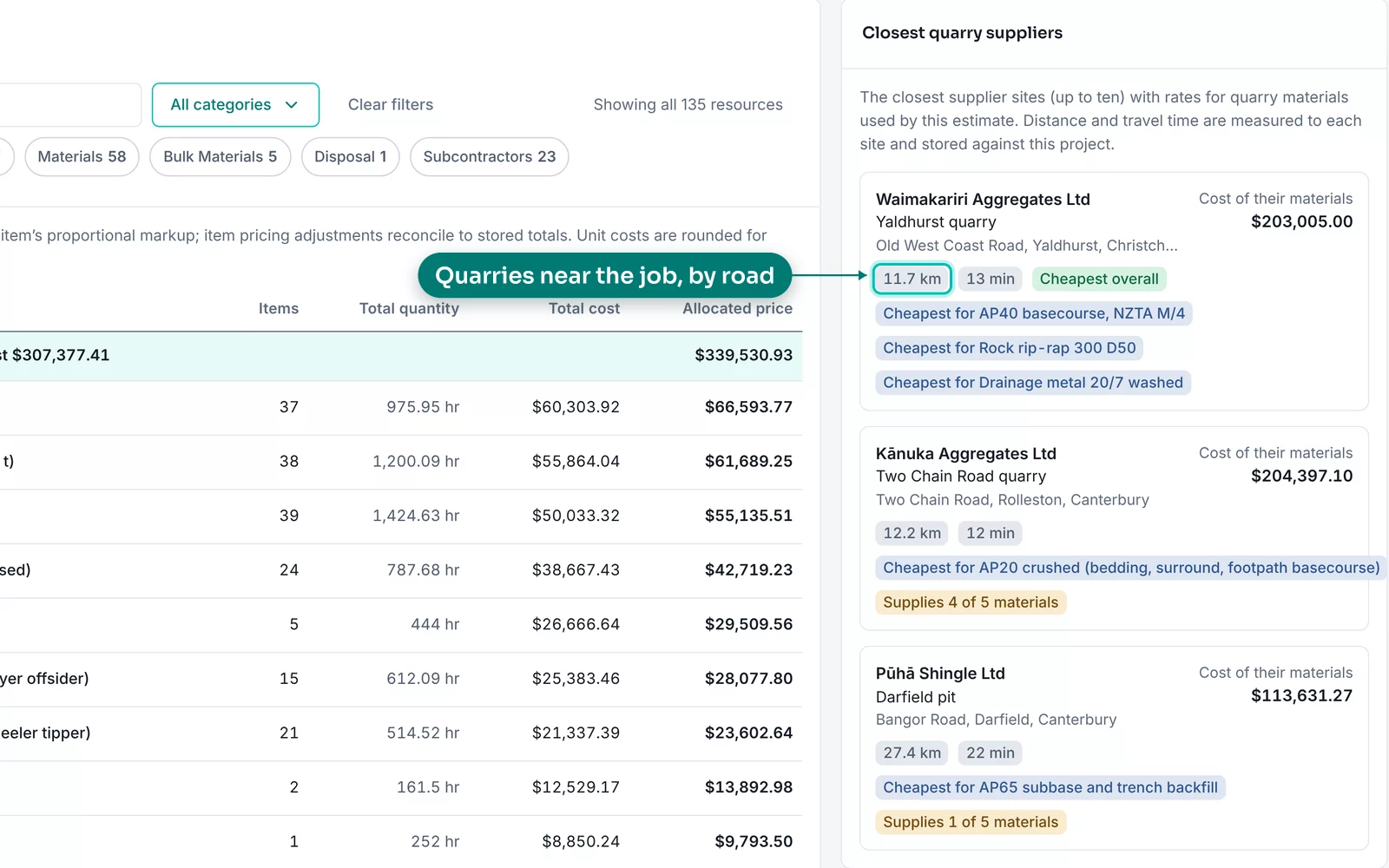
Your closest quarry supplier sites by road, with drive time and what each would cost on this job. Example suppliers and prices. -
Check it and send it back.
Tender review compares quantities with your takeoff and flags item 3.07: 201 m of lot connections scheduled, 223.7 m measured. Then 3.01 goes back in the client’s own workbook at NZ$439.96 a metre, NZ$96,791.20.
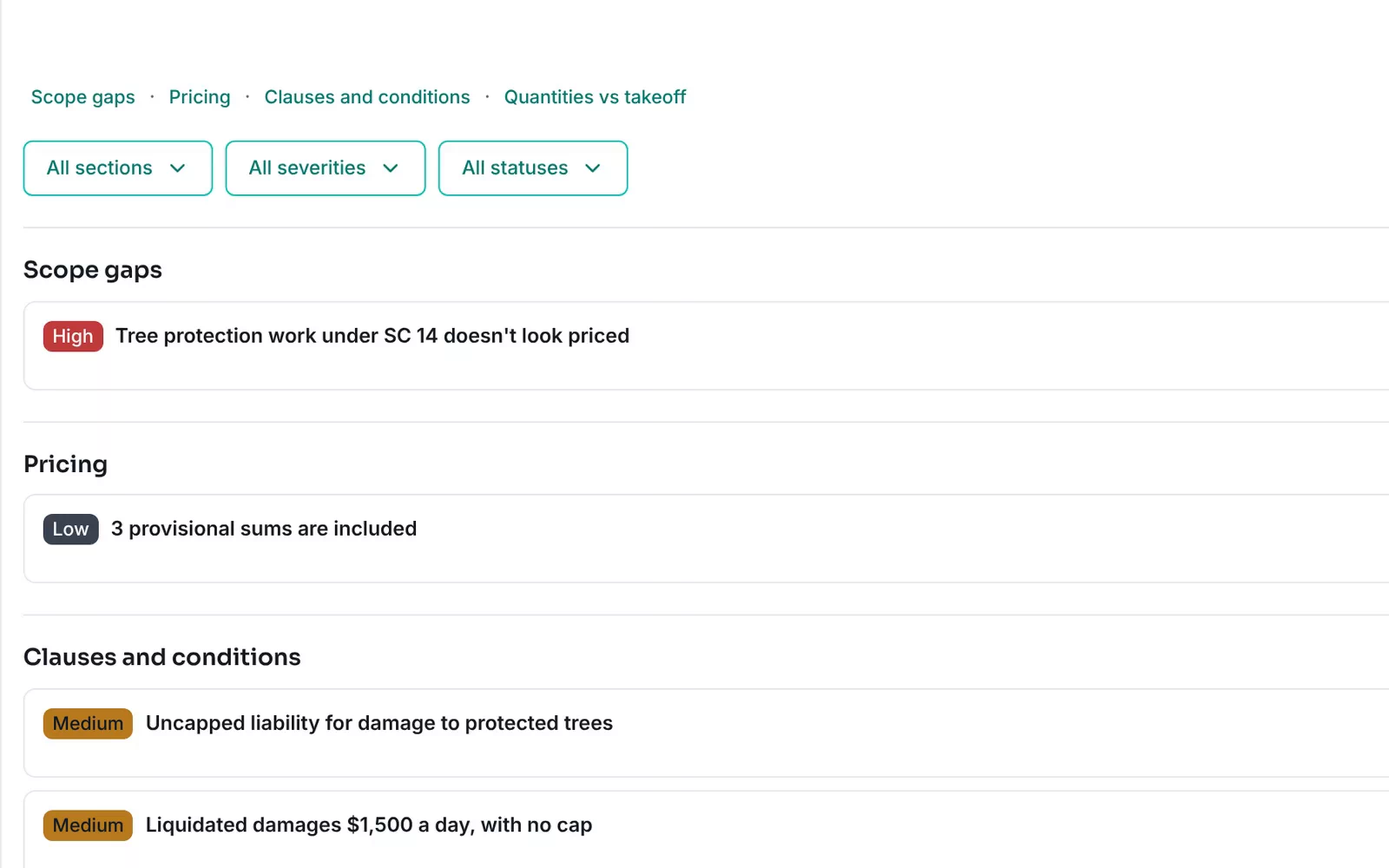
Recorded in Stralos: the tender review’s findings, then 3.07’s quantity against the takeoff. Example job. 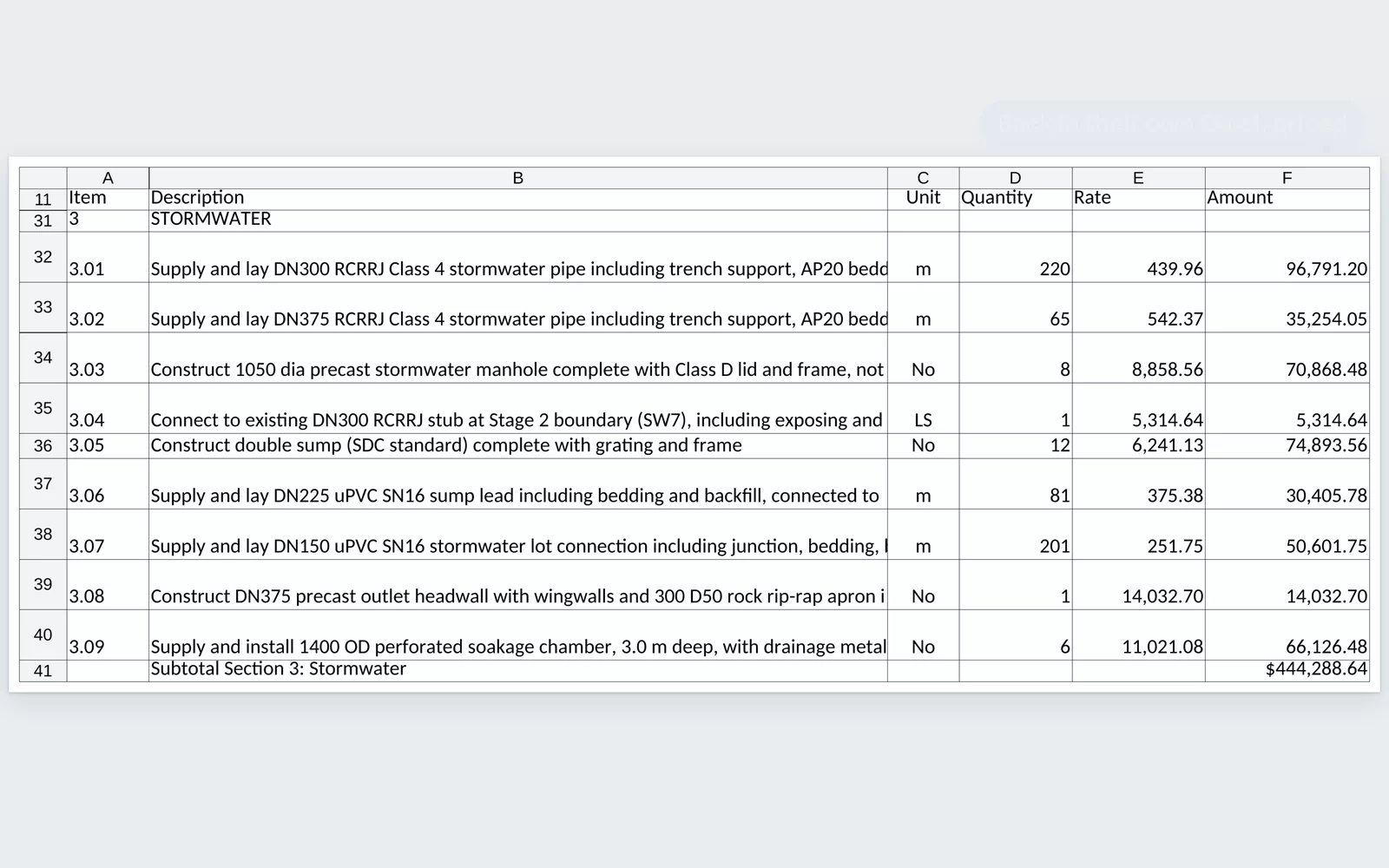
Recorded in Stralos: the client’s own workbook with section 3 priced, 3.01 at NZ$439.96 a metre. Example job and rates.
Where the rest is priced on this job. Traffic management, testing and CCTV, and as-builts sit under preliminary and general, where the client scheduled them. Dewatering is rate only.
A renewal in the road, by hand. Here’s the sum. 340 m of DN375, trench 1.10 m wide: 190 m at 1.80 m deep is 376.20 m³, 150 m at 2.30 m is 379.50 m³. In Stralos that’s two trench calculations, one for each depth. Trim the code’s minimum of 150 mm each side and the seal goes back at least 1.40 m wide: 476 m², not 374 m², before the corridor manager asks for more. Traffic management, bypass pumping and lateral reconnections are priced on top.
Worked example, not a recording
| Length | Width | Depth | Works out at | |
|---|---|---|---|---|
| 1.5 to 2.0 m deep | 190 m | 1.10 m | 1.80 m | 376.20 m³ |
| 2.0 to 2.5 m deep | 150 m | 1.10 m | 2.30 m | 379.50 m³ |
| Seal, trench width | 340 m | 1.10 m | 374 m² | |
| Seal, with the 150 mm trim each side | 340 m | 1.40 m | 476 m² |
What you start with
Sign up as “Drainage & utilities” and your rate library starts with 17 categories, among them Pipe, Fittings, Manholes & pits, Bedding material, Spoil and Vacuum truck. It holds your own rates and your suppliers’ price lists. Ask us and we’ll load your price list into your rate library for you.
Questions
Can Stralos work out a drainage cost per metre?
Yes, from your production rate, crew, plant, pipe, metal and disposal. In the example, 220 m of DN300 costs NZ$397.69 a metre.
Does it handle trenches deeper than 1.5 m?
The trench calculator takes any depth, a batter and several ground layers. Shields go in the price as plant. Deciding when a trench needs support stays with you.
Can I price a manhole?
Yes. The Pit / Structures calculator works out the hole and the backfill around the structure, and an assembly holds the precast base, risers, lid slab, frame and cover for one manhole.
Which councils’ pipes can I see on the map?
Stormwater, wastewater and drinking water from more than 25 councils and water providers. Click a pipe for what the council records, such as material, and diameter where they publish one. It isn’t nationwide: Auckland is water and wastewater only, and Dunedin and Invercargill city aren’t covered.
Last reviewed
Price your next drainage job in Stralos.
Free on Starter: everything in Standard for one person, with up to 5 active projects and 2 AI reviews a month. No card. When you add people or go past 5 active projects, Standard is NZ$199 per user per month + GST. Lite, for quotes, is NZ$99 + GST.