
Industries
Utilities estimating software for power, gas and fibre trenching
Stralos is estimating software for utility contractors laying power, gas and fibre: cable and duct trenches, directional drilling, pits and chambers, and the reinstatement after. Take off the run by surface, let the trench calculator work out the dig with every duct in it, and price each metre from your own crew, plant and subcontractors.
Free on Starter: everything in Standard for one person, with up to 5 active projects and 2 AI reviews a month. No card. When you add people or go past 5 active projects, Standard is NZ$199 per user per month + GST. Lite, for quotes, is NZ$99 + GST.
What makes utilities work hard to price?
-
Each network wants its own trench.
Chorus’s lead-in guide asks for fibre 450 mm below finished ground, or 300 mm under a permanent surface such as a concrete drive. Vector’s gas service guide wants 450 mm to 1,200 mm of cover in a trench at least 600 mm deep. Price the dig to the network owner’s own specification.
Source: Chorus urban service lead guide
-
The surface changes every few metres.
A run goes from grass berm to footpath to driveway to carriageway, and each is dug and reinstated differently. In a road corridor, the national code wants the reinstatement trimmed at least 150 mm beyond the original saw cut, with a two-year warranty on the work.
Source: National Code of Practice for Utility Operators’ Access to Transport Corridors
-
What’s already in the ground.
A beforeUdig enquiry is free, though some asset owners charge for plans or a locate. The locating, potholing and hydro excavation near live services that follow are time and money, and the schedule may not name them.
How a duct run is priced in Stralos
There’s no utilities example job yet, so these steps show how a duct run is priced in Stralos. The recordings come from the Riverbend example job, a 28-lot subdivision priced by the fictional Kesterton Civil Ltd, whose schedule leaves power and telecommunications to the network operators’ contractors. Each caption says what it shows.
-
Take off the run by surface.
Measure the run as one Multi-segment line and tag each stretch: berm, footpath, driveway, carriageway. Each tag keeps its own subtotal and can be its own item or its own trench. No drawing? Measure it on LINZ aerial or Google Maps satellite with the property boundaries on, and count the pits and pillars as you go.
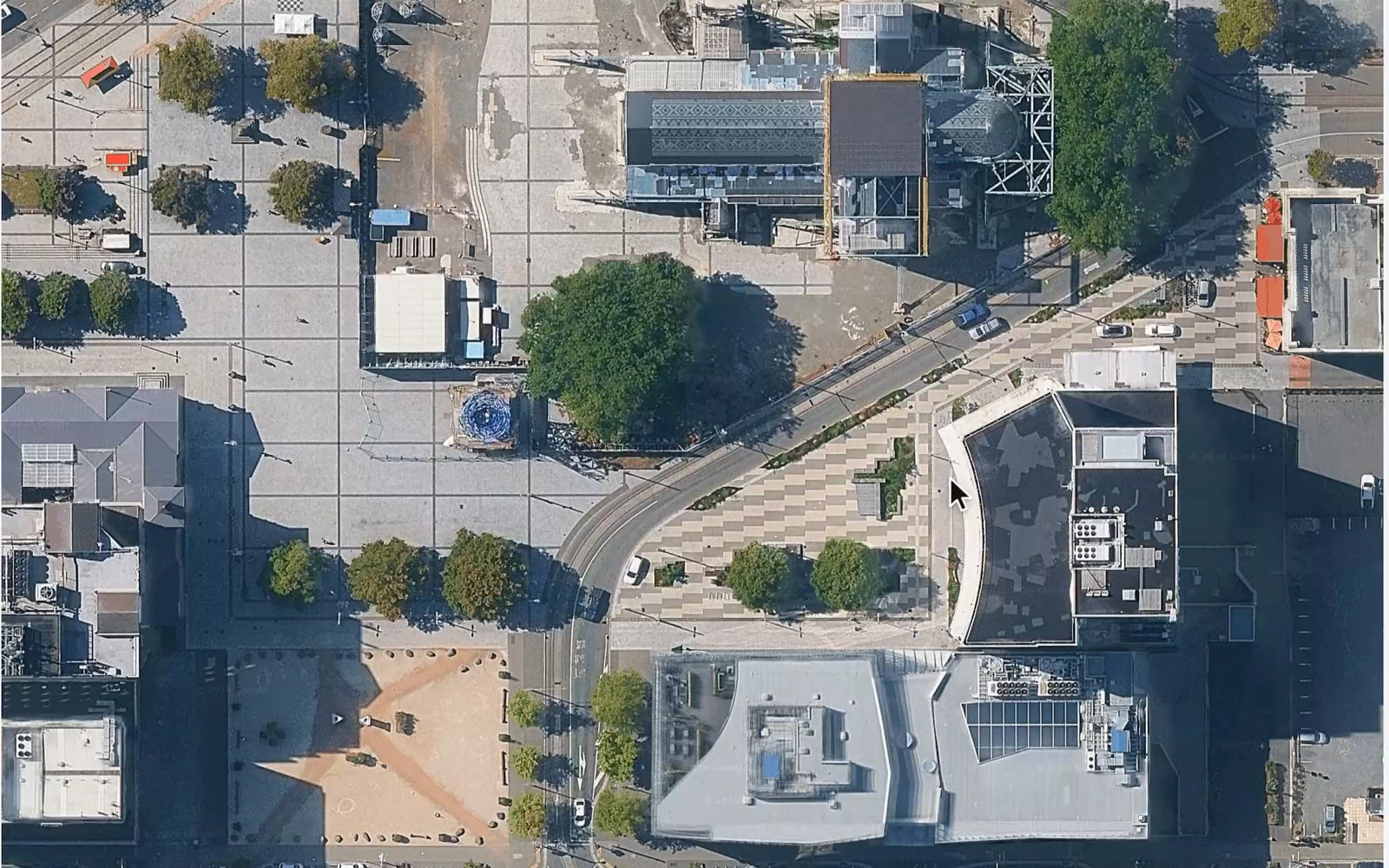
Recorded in Stralos: Cathedral Square, Christchurch, on LINZ aerial with property boundaries and the council’s pipes. The council layers are stormwater, wastewater and drinking water only: power, gas and fibre come from your locate.Aerial imagery and property boundaries: Toitū Te Whenua LINZ, CC BY 4.0. Pipe data: Canterbury Maps and partners, CC BY 4.0. -
Every duct in one trench.
Set the trench width and depth from the network’s specification, then add each duct or pipe by its outside diameter, with the gap between them, or none for bundled ducts. The trench calculator works out the dig, the bedding with the ducts netted out, the backfill and the cart-away, and takes its length from a takeoff tag.
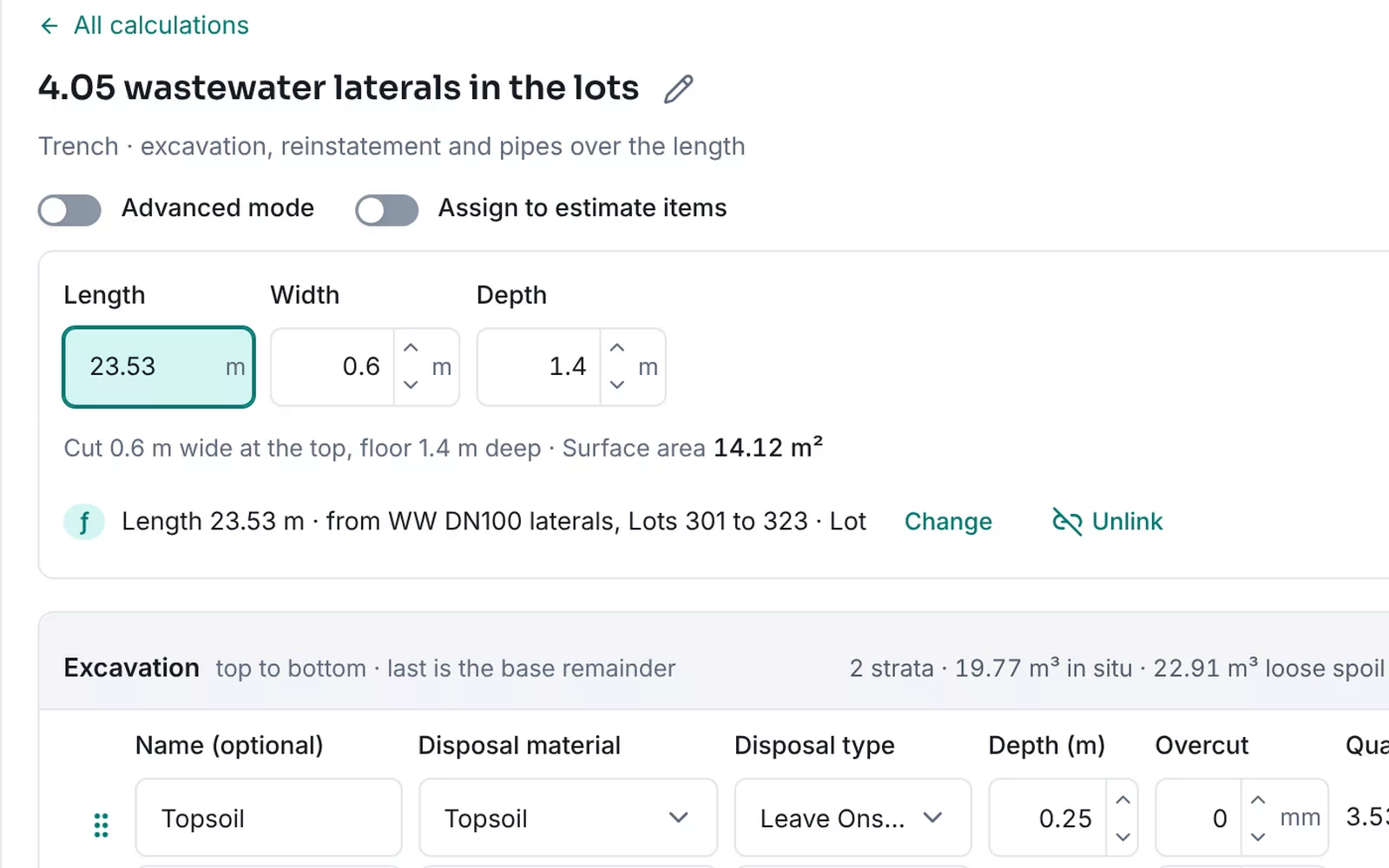
Recorded in Stralos: a lateral trench on the example job, with topsoil and gravel reused, the surplus carted, then the trench turned in 3D. Example job. -
Reinstate each surface.
Each surface is its own trench with its own layers going back: topsoil and grass in the berm, basecourse and concrete under a footpath, basecourse and asphalt in the road. A layer bought in is priced from your library, by the tonne, the m³ or the m².
-
Pits, drilling and the specialists.
The Pit / Structures calculator works out the dig and backfill around a pit or chamber, with the structure netted out. An assembly holds the pit, lid and fittings for one, priced once and counted. Directional drilling, hydro excavation, service location and traffic management go in as subcontractor rates, a drill shot by the metre or each, with each subcontractor’s base measured by road from the job.
-
Set the crew and price each metre.
Price each metre from your own crew, excavator, trucks and ducts, with a production rate in metres a day. Working nights for a road closure? Add a Night rate beside the standard one and pick it on the lines that need it.
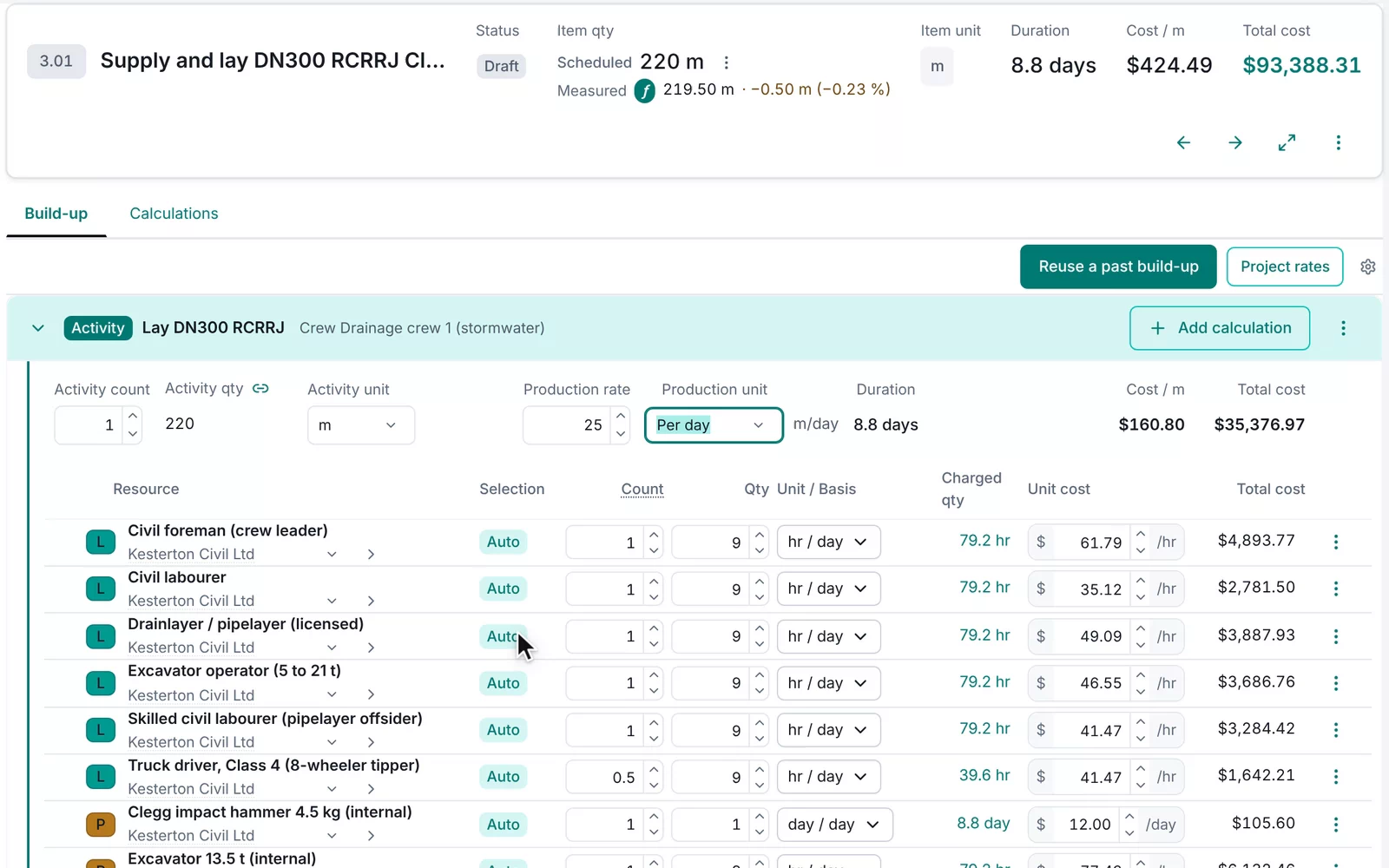
Recorded in Stralos: a production rate changing on the example job’s stormwater pipe, and the days, hours and cost per unit following. Example job and rates. -
The network’s schedule, and dayworks.
Network work often comes as a schedule of rates. Bring in the client’s schedule with its numbering kept and send their own workbook back priced, on Standard. Keep your agreed day rates for plant and labour in a day rates schedule, and pick them into a quote for dayworks.
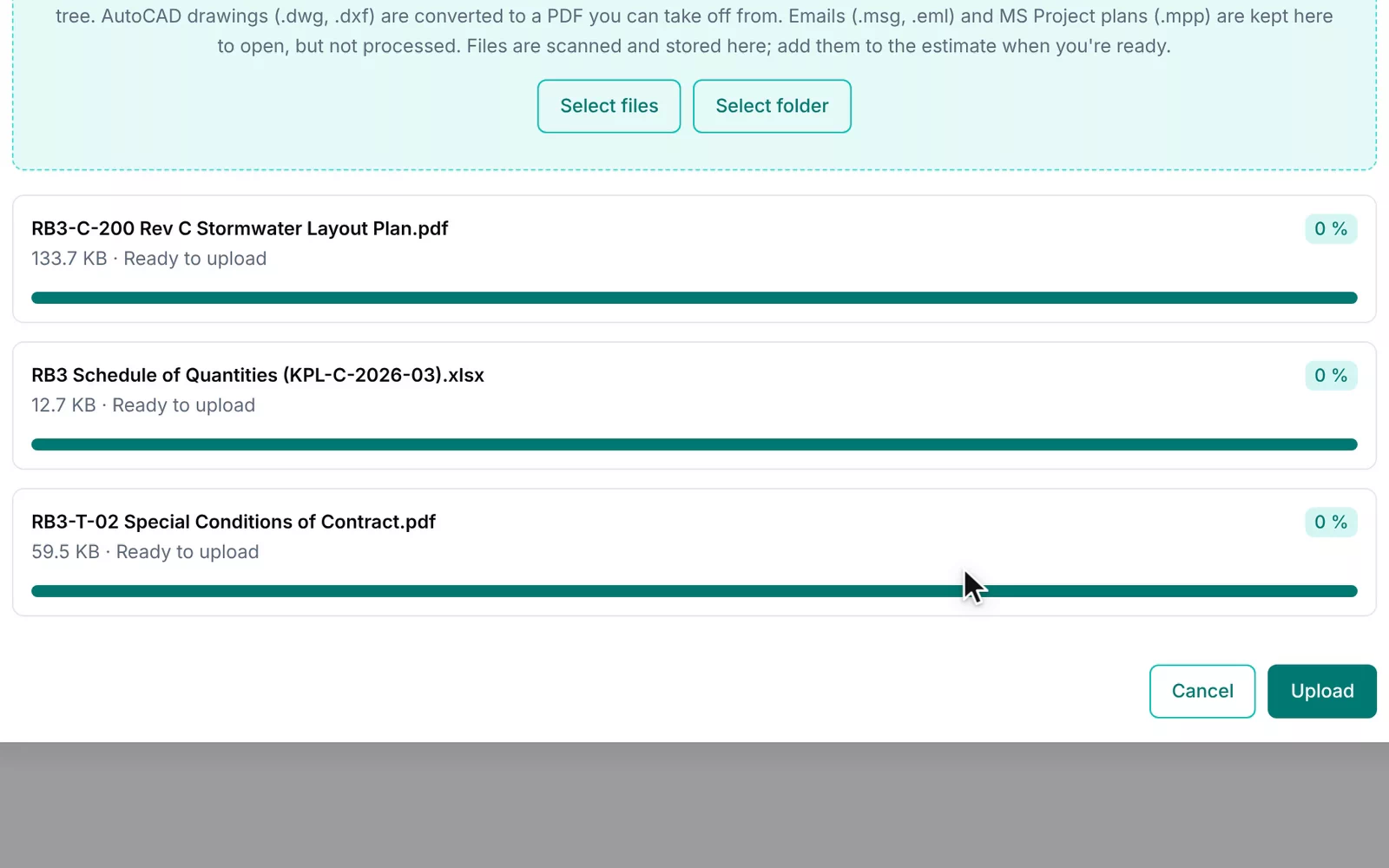
Recorded in Stralos: the tender pack goes in and the client’s schedule comes through with their numbering kept. Example job.
A 600 m duct run, by hand. Here’s the sum for a trench 0.45 m wide and 0.9 m deep across three surfaces. In Stralos that’s one takeoff line with three tags, and a trench for each. The footpath goes back at least 0.75 m wide once the code’s 150 mm trim each side is added.
Worked example, not a recording
| Length | Width | Depth | Works out at | |
|---|---|---|---|---|
| Grass berm | 380 m | 0.45 m | 0.90 m | 153.90 m³ |
| Footpath | 150 m | 0.45 m | 0.90 m | 60.75 m³ |
| Driveway crossings | 70 m | 0.45 m | 0.90 m | 28.35 m³ |
| Footpath reinstatement, with the trim | 150 m | 0.75 m | 112.50 m² |
What Stralos doesn’t do. The map’s council layers are stormwater, wastewater and drinking water from more than 25 councils and water providers. There are no power, gas or fibre layers: those come from your beforeUdig plans and locate, as they do now. Stralos doesn’t design cable routes or bores.
What you start with
Sign up as “Drainage & utilities” and your rate library starts with 17 categories, among them Pipe, Fittings, Manholes & pits, Bedding material, Traffic management and Vacuum truck. Your takeoff starts with Power, Telecommunications and Gas beside stormwater, wastewater and water. An admin can add the civil starter categories too, such as Directional Drilling, Hydro & Air Excavation, Service Location and Electrical & Utility Components. It holds your own rates and your suppliers’ price lists. Ask us and we’ll load your price list into your rate library for you.
Questions
Can one trench hold several ducts?
Yes. Add each duct or pipe by its outside diameter and set the gap between them. The bedding they sit in has their volume netted out.
Does Stralos show power, gas or fibre on the map?
No. The council layers are stormwater, wastewater and drinking water from more than 25 councils and water providers. Power, gas and fibre come from your beforeUdig plans and locate.
Can I price directional drilling?
Yes, as your driller’s rate by the metre or by the shot, or from your own rig and crew with a production rate. Stralos doesn’t design the bore.
Can I price dayworks and call-outs?
Yes. Keep your agreed day rates for plant and labour in a day rates schedule and pick them into a quote. A day rate is charged as it stands, with no markup on top. It’s on Lite and Standard.
Last reviewed
Price your next utilities job in Stralos.
Free on Starter: everything in Standard for one person, with up to 5 active projects and 2 AI reviews a month. No card. When you add people or go past 5 active projects, Standard is NZ$199 per user per month + GST. Lite, for quotes, is NZ$99 + GST.