
Industries
Roading estimating software for pavement and surfacing work
Stralos is roading estimating software for contractors pricing new roads, renewals and surfacing: subgrade, subbase, basecourse, asphalt and chip seal, and the kerb, footpath and marking around them. Measure the areas, build the pavement in layers, and get each layer in m³ and tonnes, priced from your own crews and plant and your quarry suppliers, each measured by road from the job.
Free on Starter: everything in Standard for one person, with up to 5 active projects and 2 AI reviews a month. No card. When you add people or go past 5 active projects, Standard is NZ$199 per user per month + GST. Lite, for quotes, is NZ$99 + GST.
What makes roading hard to price?
-
The schedule pays by the square metre. The quarry bills by the tonne.
Riverbend’s items 6.01 and 6.02 schedule 300 mm of AP65 subbase and 150 mm of AP40 basecourse over 2,295 m². Getting to tonnes takes the compacted depth, the compaction and each supplier’s density, and those aren’t the same from one quarry to the next.
-
Basecourse comes in classes.
NZTA M04:2024 replaced M/4:2006 and sets four classes of basecourse quality, chosen for the loading the road will carry. Check which class the specification calls for before you price a quarry’s product.
Source: NZTA M04:2024 specification for basecourse aggregate
-
Traffic management is changing guides.
NZTA stopped using CoPTTM for state highway worksites from 1 November 2024 in favour of NZGTTM, and councils are moving on their own dates, some from 1 July 2026. Check which one the road controlling authority wants before you price the traffic management plan.
Source: NZTA, rolling out the NZGTTM
One job, priced in Stralos: Riverbend Stage 3’s roading
Example job and company: Riverbend Stage 3, a 28-lot subdivision in Selwyn District, priced by the fictional Kesterton Civil Ltd. Section 6 of the client’s schedule is the roading. These items are described from the schedule; the recordings show other items on the same job, and each caption says which.
-
Bring in the schedule.
Stralos suggests the client’s schedule with their numbering kept: 6.01 subbase and 6.02 basecourse over 2,295 m², 6.03 AC10 surfacing over 2,005 m², 6.04 481 m of kerb and channel and 6.05 495 m² of footpath. Accept it and the estimate locks to theirs. (On Standard, and free on Starter.)
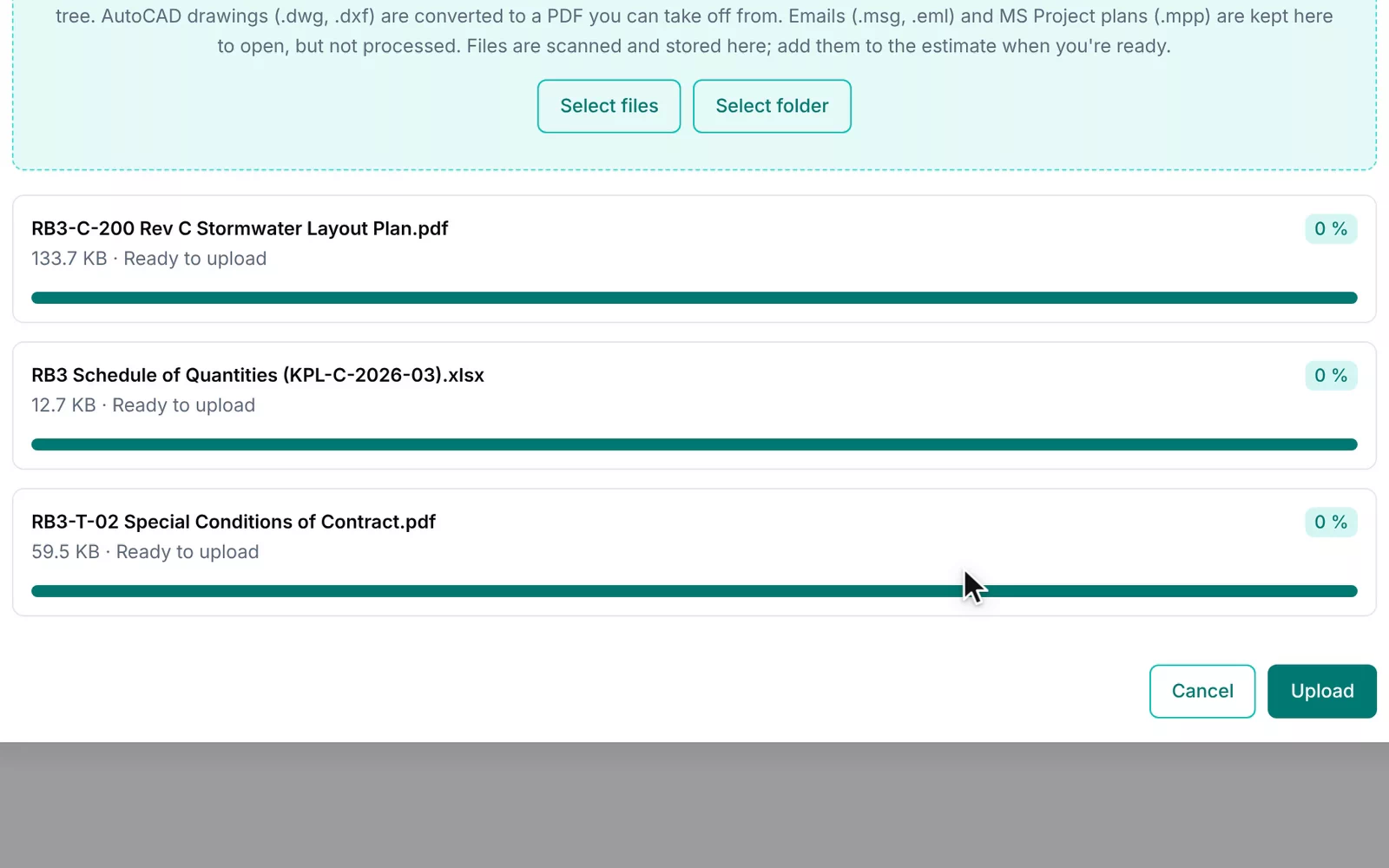
Recorded in Stralos: the tender pack goes in and the client’s schedule comes through with their numbering kept. Example job. -
Measure the pavement.
Take off the carriageway as an area to check the 2,295 m², the kerb lines as runs and the pram crossings as counts. Your measured quantity sits beside theirs. On a renewal with no drawing, measure the existing road on LINZ aerial or Google Maps satellite.
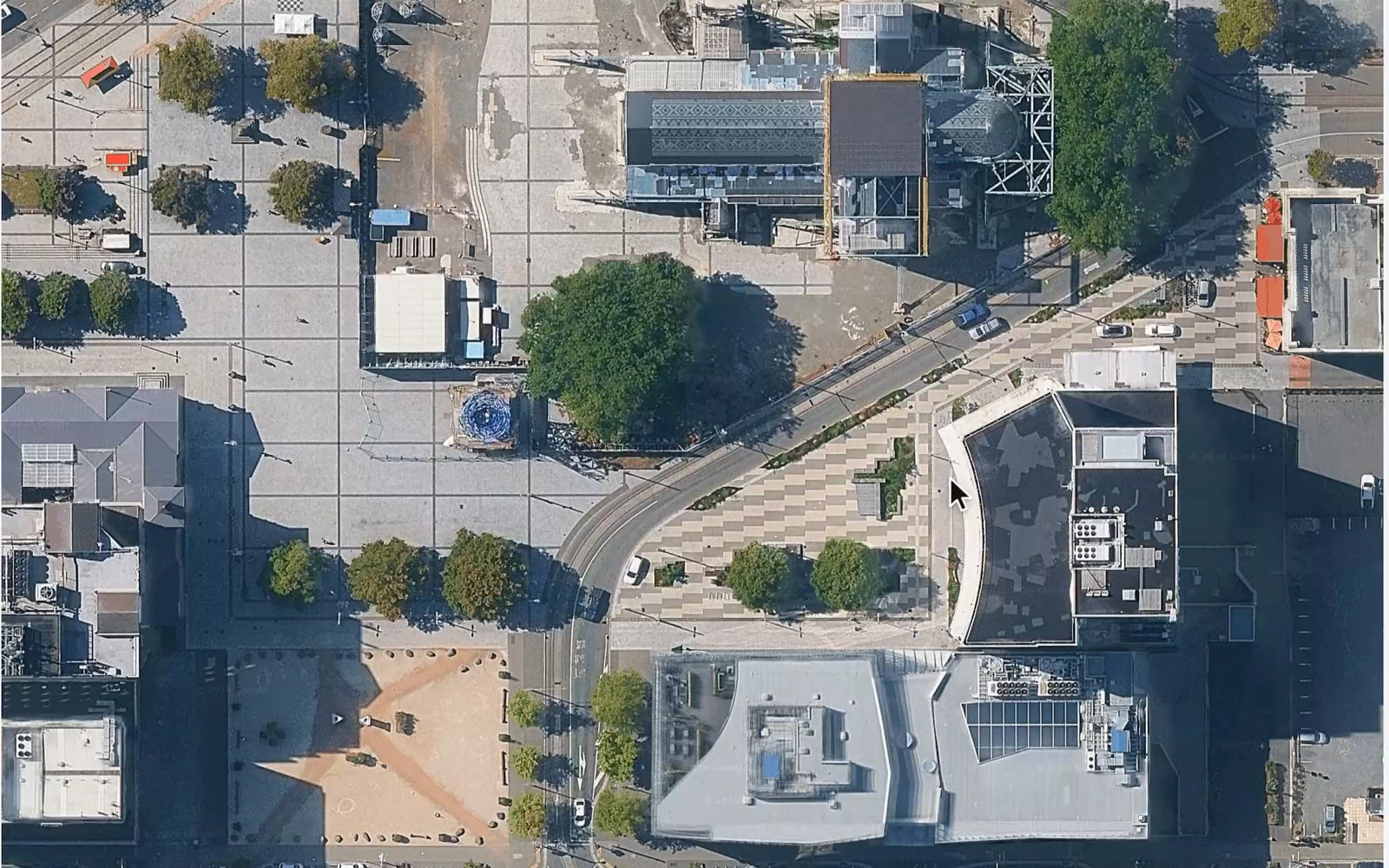
Recorded in Stralos: Cathedral Square, Christchurch, on LINZ aerial with property boundaries and the council’s pipes. A different site from the example job.Aerial imagery and property boundaries: Toitū Te Whenua LINZ, CC BY 4.0. Pipe data: Canterbury Maps and partners, CC BY 4.0. -
Build the pavement in layers.
On an item measured in m², the Volume calculator starts from the item’s own quantity, so you enter the depths. Put in the boxing as the dig, then the layers from the bottom up: 300 mm of AP65, 150 mm of AP40, and the asphalt priced by the m². Pick a bulk material for a layer and its volume becomes tonnes to buy, from its compaction and the supplier’s density. Where suppliers’ densities differ, you see the range.
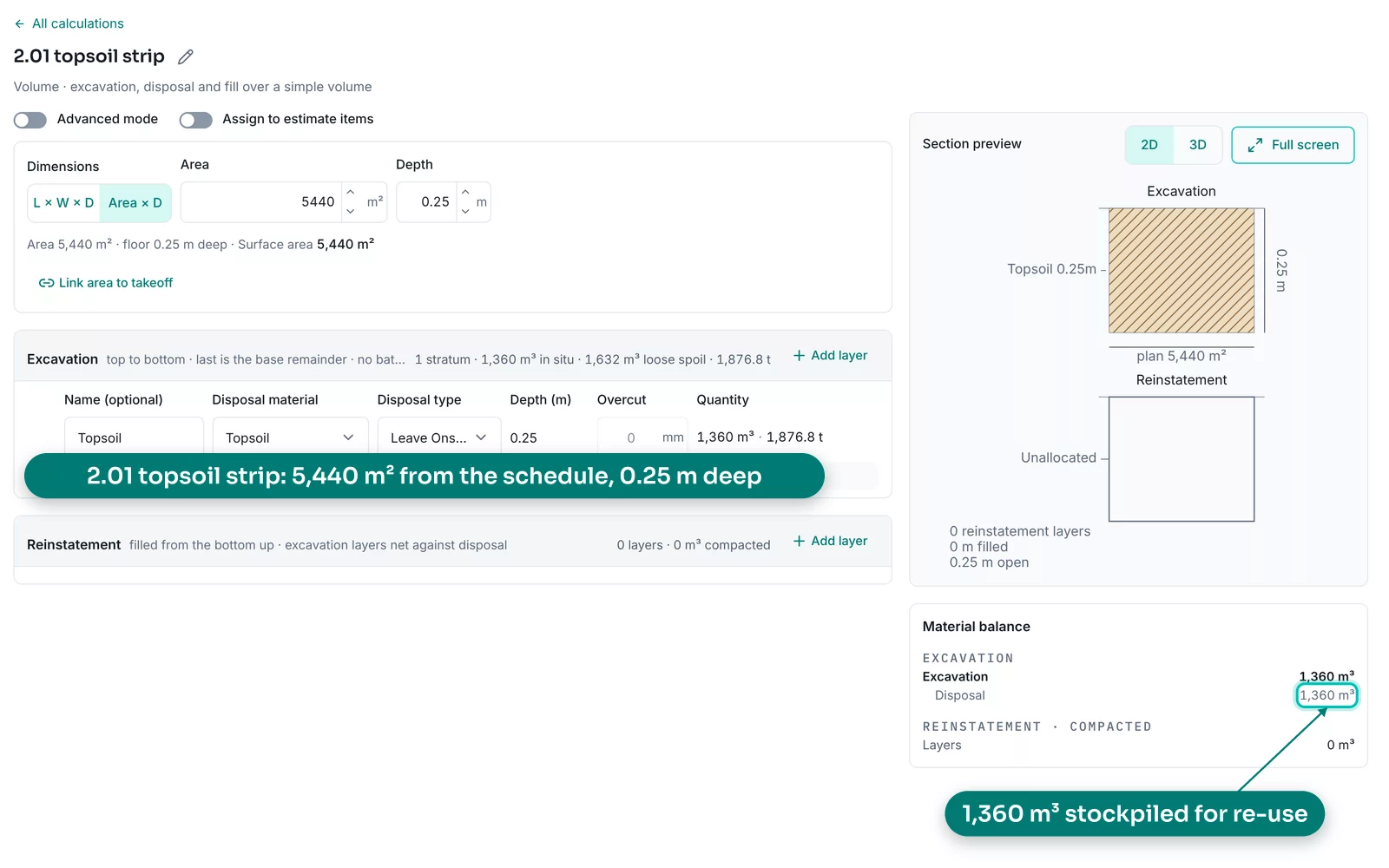
The Volume calculator: on the example job’s topsoil strip, item 2.01, 5,440 m² at 0.25 m deep, 1,360 m³. Example job. -
Find the closest quarry.
On a Tender job, the estimate’s Overview lists up to ten of your closest quarry supplier sites, ranked by road distance, with drive time. Here Waimakariri Aggregates at Yaldhurst is 11.7 km and 13 minutes away. Cartage is its own line, so you can weigh the haul before you pick.
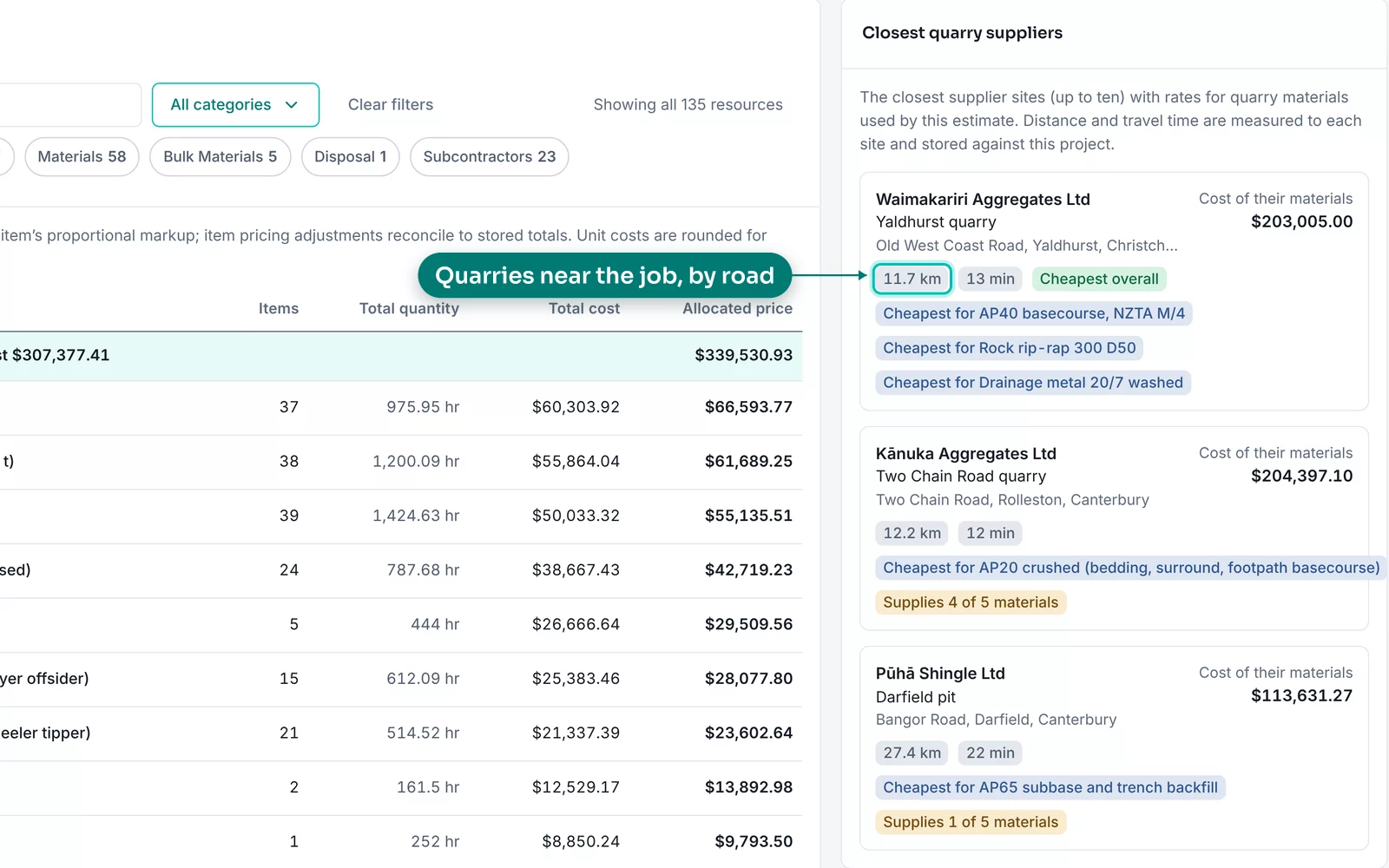
Your closest quarry supplier sites by road, with drive time and what each would cost on this job. Example suppliers and prices. -
Set the crew and the shift.
Price the paving crew, paver, rollers and trucks with a production rate in m² or tonnes a day. Working nights? Add a Night rate beside the standard one and pick it on the lines that need it. Traffic management goes in by the day, from your own crew or a subcontractor’s rates.
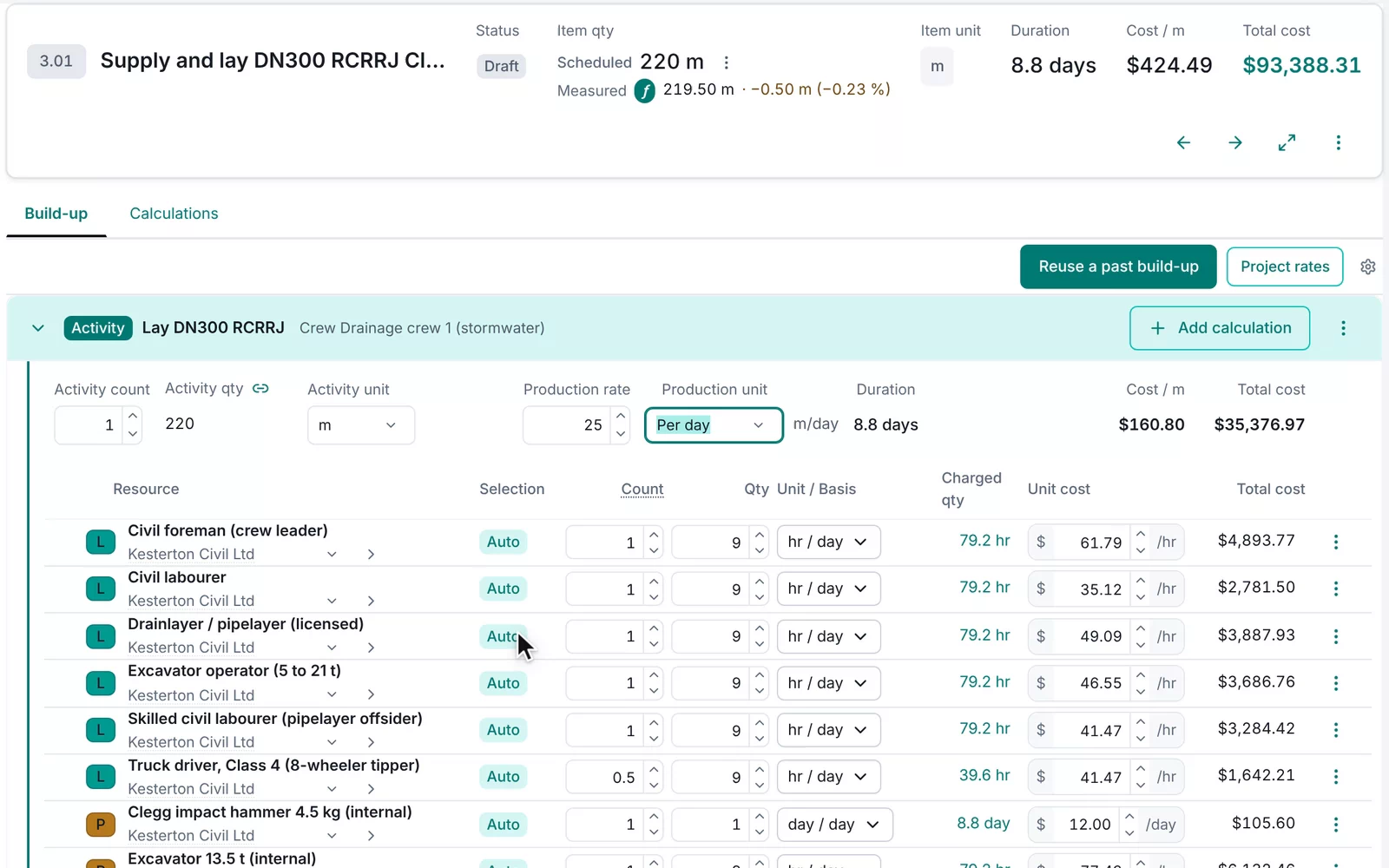
Recorded in Stralos: a production rate changing on the example job’s stormwater pipe, and the days, hours and cost per unit following. Example job and rates. -
Check it and send it.
Tender review flags truck hours more than 25% short of, or over, what the material you’re moving needs, and quantities more than 10% away from your takeoff. Then the client’s own workbook goes back priced. (On Standard, and free on Starter.)
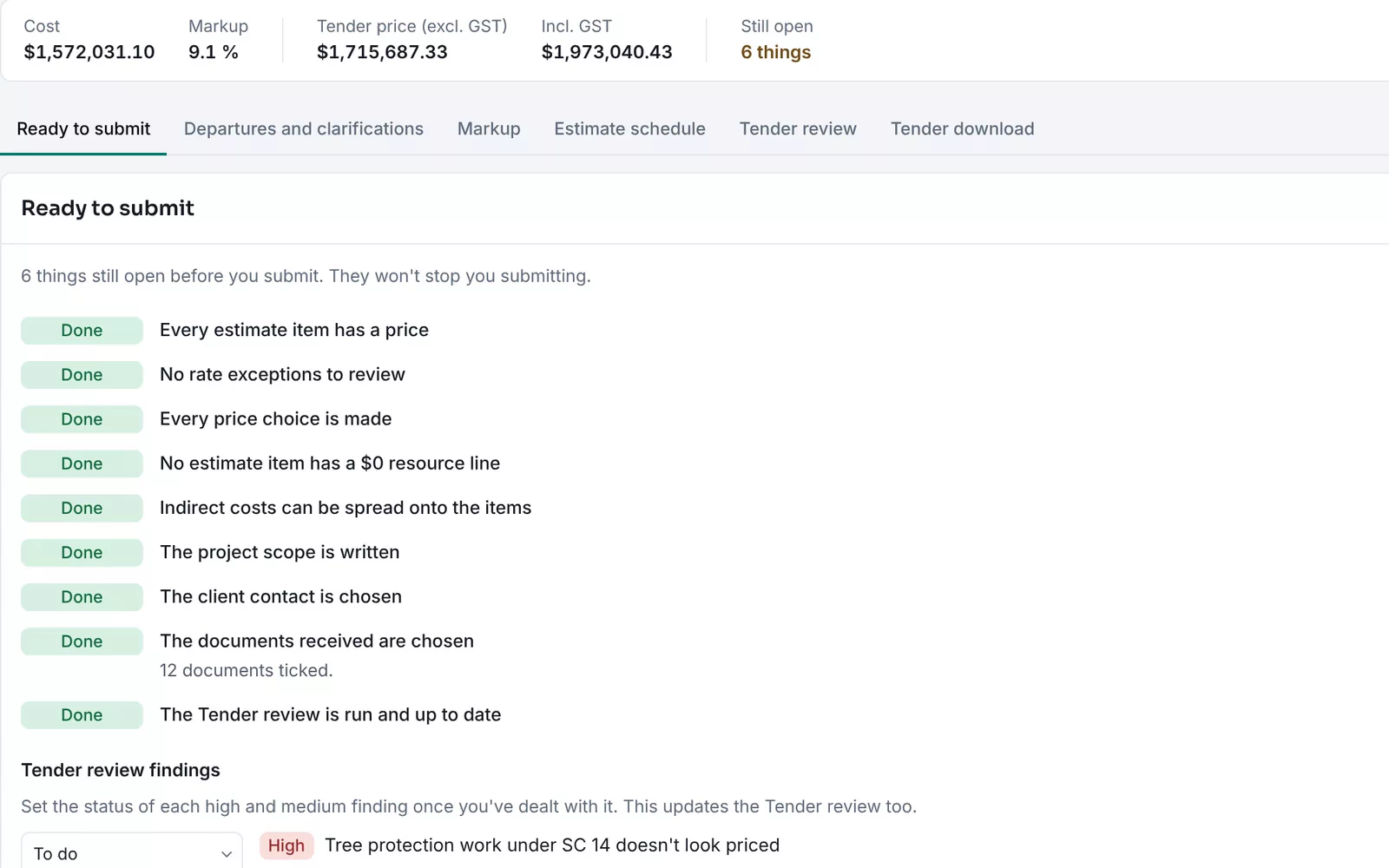
Recorded in Stralos: Ready to submit, the downloads, then the client’s own workbook with section 3 priced. Example job and rates.
Riverbend’s pavement, by hand. Here are the compacted volumes from the schedule. Turning them into tonnes to buy takes the compaction and the density of the product you buy, which Stralos takes from each supplier’s price.
Worked example, not a recording
| Area | Depth | Works out at | |
|---|---|---|---|
| 6.01 AP65 subbase | 2,295 m² | 0.300 m | 688.50 m³ compacted |
| 6.02 AP40 basecourse | 2,295 m² | 0.150 m | 344.25 m³ compacted |
| 6.03 AC10 surfacing | 2,005 m² | 0.030 m | 60.15 m³ |
What Stralos doesn’t do. There’s no dedicated pavement or kerb calculator: pavement layers go in the Volume calculator, and chip seal and asphalt are priced by the m². It doesn’t design seals or work out bitumen and chip application rates, and it doesn’t connect to RAMM.
What you start with
Sign up as “Roading & surfacing” and your rate library starts with 17 categories, among them Asphalt, Chip seal, Basecourse, Pavers, Line marking and Traffic management. Your takeoff starts with Pavement, Asphalt, Chipseal, Kerb & Channel, Footpaths and Road Marking. It holds your own rates and your suppliers’ price lists. Ask us and we’ll load your price list into your rate library for you.
Questions
Can it turn basecourse into tonnes?
Yes. Pick the bulk material for the layer and its compacted volume becomes tonnes to buy, using its compaction and the supplier’s density. Where suppliers’ densities differ, you see the range.
Does it price chip seal?
Yes, by the m² from your own rates or your sealing subcontractor’s. It doesn’t work out bitumen or chip application rates.
Can I price a road renewal with no drawings?
Yes. Add a map sheet and measure the road on LINZ aerial or Google Maps satellite. Lengths and areas come from each point’s real position, so there’s no scale to set.
Does it work for NZS 3910 and NZS 3917 contracts?
Yes. Set the contract form on the project, and Tender review reads the conditions in your own tender documents, special conditions included.
Last reviewed
Price your next roading job in Stralos.
Free on Starter: everything in Standard for one person, with up to 5 active projects and 2 AI reviews a month. No card. When you add people or go past 5 active projects, Standard is NZ$199 per user per month + GST. Lite, for quotes, is NZ$99 + GST.