
Industries
Concrete estimating software for kerb, path and slab crews
Stralos is concrete estimating software for contractors pricing kerb and channel, footpaths, driveways, slabs and foundations. Take off the kerb lines, paths and slabs on the drawing, then price each one from your own crew, pump, formwork, mesh and ready-mix, with a production rate in metres or square metres. Send a quote, or the client’s schedule back priced.
Free on Starter: everything in Standard for one person, with up to 5 active projects and 2 AI reviews a month. No card. When you add people or go past 5 active projects, Standard is NZ$199 per user per month + GST. Lite, for quotes, is NZ$99 + GST.
What makes concrete work hard to price?
-
One metre of kerb carries a lot.
Riverbend’s item 6.04 reads “Construct kerb and channel (SDC standard profile) including kerb returns and cul-de-sac head”: 481 m. The trim, the basecourse, the concrete, the machine or the boxing, the crew, the returns and the backfill behind it all sit inside one rate a metre, to the council’s own profile.
-
Ready-mix isn’t one price a cubic metre.
Supplier terms can add a small load fee, a charge for concrete sent back, an extra charge for delivery outside normal hours, and a fuel surcharge by the cubic metre. A small pour can cost more a cubic metre than a big one.
Source: Firth Terms of Trade
-
The specification sets the work, not just the mix.
NZS 3109:1997 sets how concrete designed to NZS 3101 is built, from formwork and reinforcement to placing and curing. The inspections, tests and hold points in the specification are time on site, and they belong in the price.
How a concrete job is priced in Stralos
Example job and company: Riverbend Stage 3, a 28-lot subdivision in Selwyn District, priced by the fictional Kesterton Civil Ltd. Its roading section has 481 m of kerb and channel and six pram crossings. The recordings show the example job’s stormwater items, and each caption says so: the concrete items are described here, not recorded.
-
Take off the kerb lines, paths and slabs.
Measure kerb and channel as a run on the drawing and tag each stretch, such as straight kerb, kerb returns and the cul-de-sac head, so each keeps its own subtotal. Paths, driveways and slabs are areas. Pram crossings are counts. Sheets that join are stitched into one site drawing, so a kerb line across a match line is one measurement.
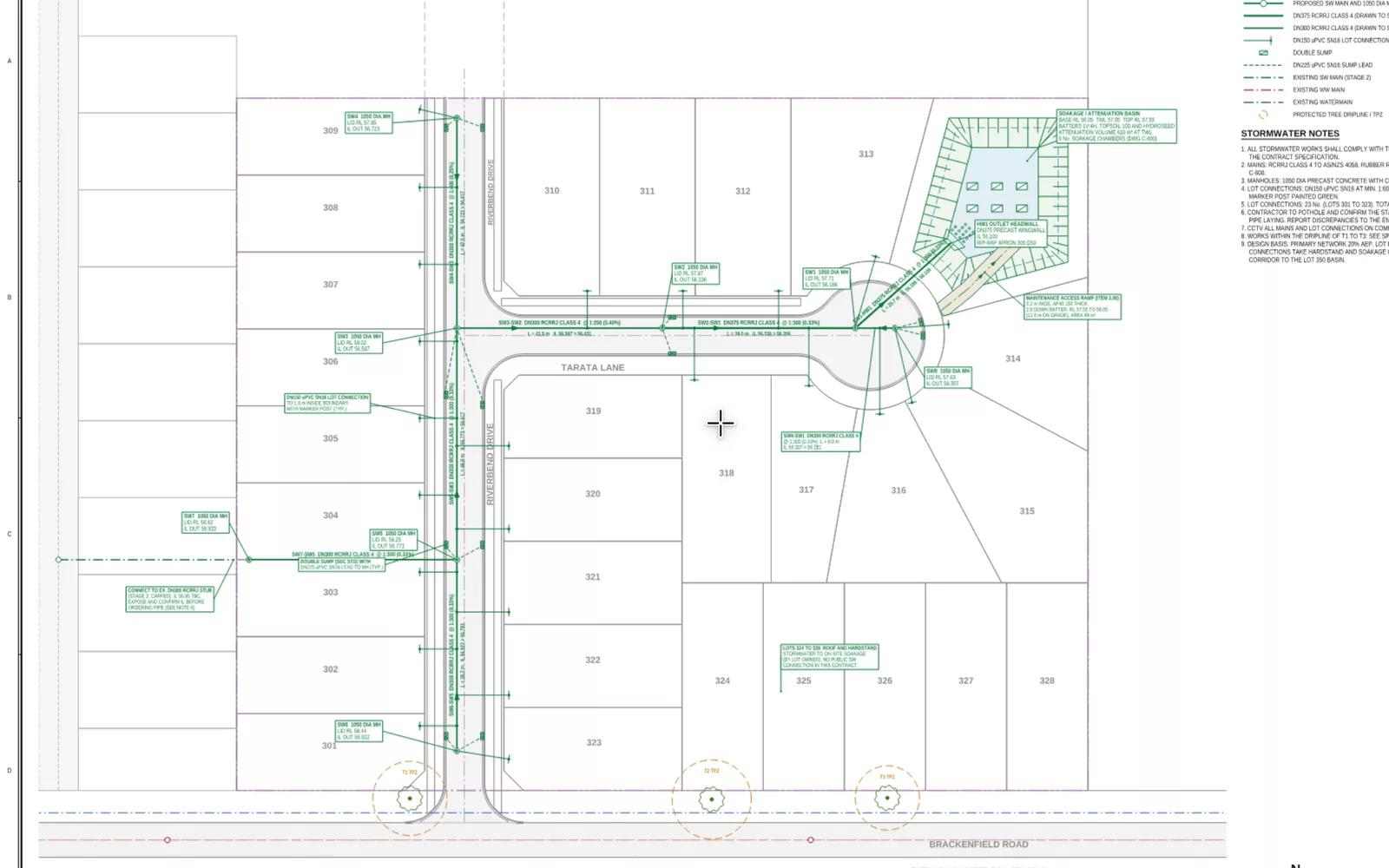
Recorded in Stralos: a run taken off on the example job’s drawing, here the DN300 stormwater, the length ticking up with each point. Kerb lines are measured the same way. -
Work out the dig and what goes back.
The Volume calculator works out the boxing for a kerb, path or slab from its length, width and depth, or its area and depth, and the layers going back from the bottom up: basecourse, then concrete. A layer can be any resource in your library, priced by its volume or its area, so the AP20 comes out in tonnes and the concrete in m³. Link the length or area to the takeoff and it follows the drawing.
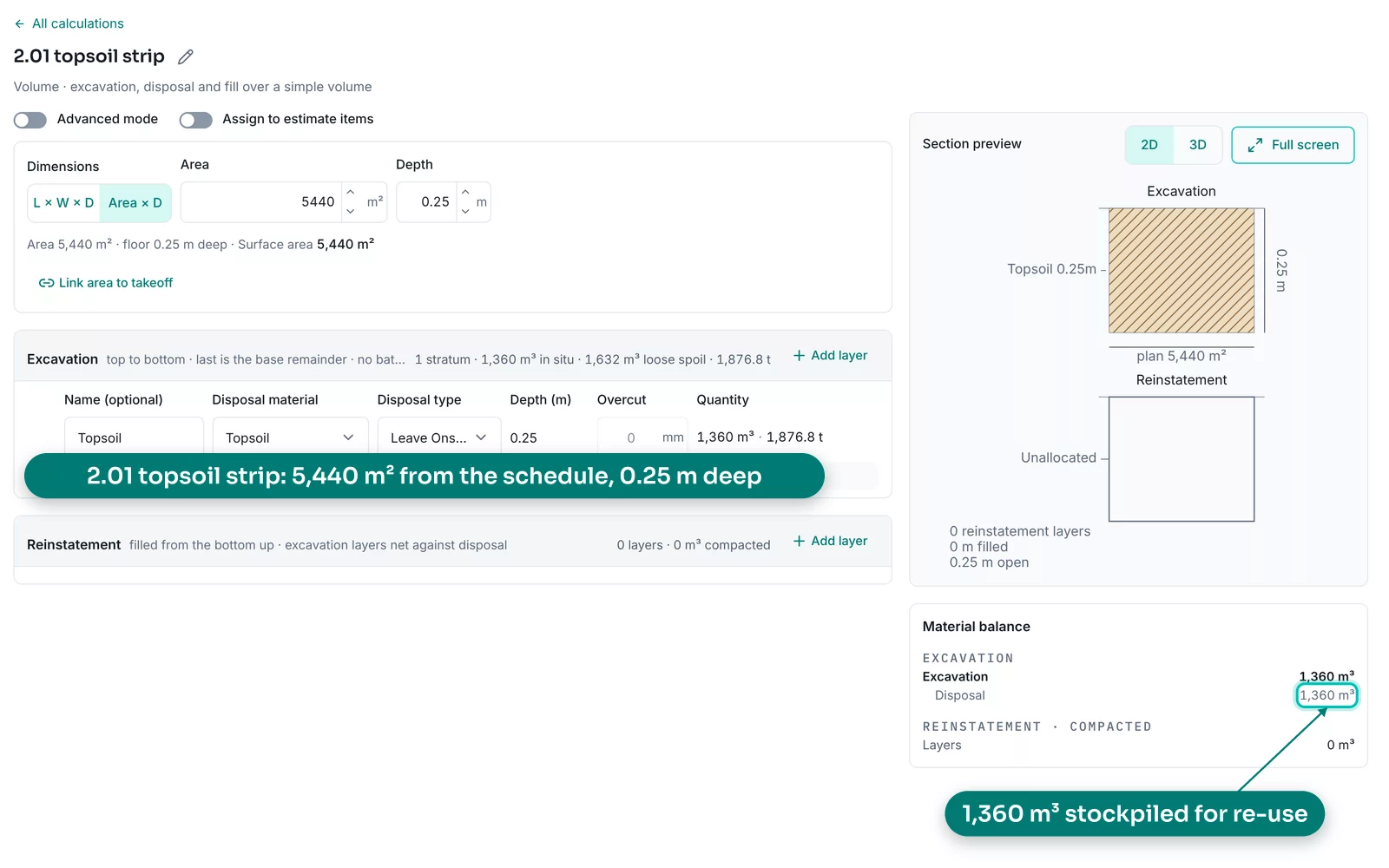
The Volume calculator: on the example job’s topsoil strip, item 2.01, 5,440 m² at 0.25 m deep, 1,360 m³. Example job. -
Build the rate from your crew and materials.
Price each item from your own crew, the kerb machine or boxing, the pump and the ready-mix, with a production rate in metres or square metres a day. A slab activity can carry the concrete per m² (0.1 m³ for a 100 mm slab) and the mesh by the sheet, and the mesh is ordered in whole sheets.
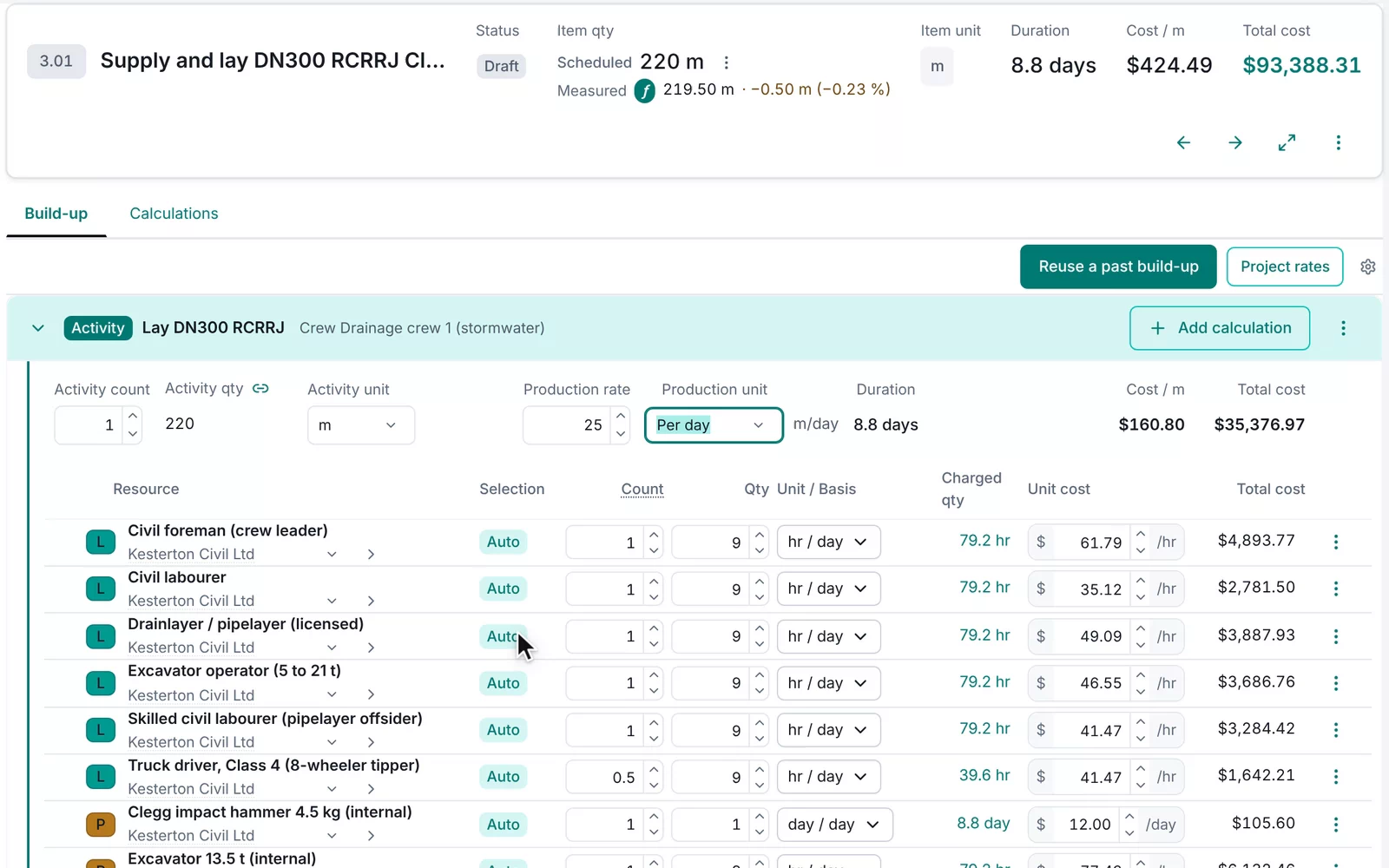
Recorded in Stralos: a production rate changing on the example job’s stormwater pipe, and the days, hours and cost per unit following. Example job and rates. -
Price the ready-mix the way the plant bills it.
Load your supplier’s price list with its quantity breaks, minimum charges and loadings, and add a Night or Weekend price beside the standard one. Each plant is a site, measured by road from the job with drive time. A quote for this job only is filed with its valid-until date, and flagged when it has 45 days or less to run.
-
Save it for the next job.
Save a priced activity, such as kerb and channel to one council’s profile, to your library with its production rates. Choices like 20 or 25 MPa can sit as extra overs in one group, so whoever adds it picks one. Your exclusions for concrete work sit under their own trade in your departures and clarifications.
-
Send a quote, or their schedule back.
No schedule? Price it as a quote, on Lite or Standard. Tendering? Bring in the client’s schedule with their numbering kept, run Tender review against the documents, and send their own workbook back priced. (On Standard, and free on Starter.)
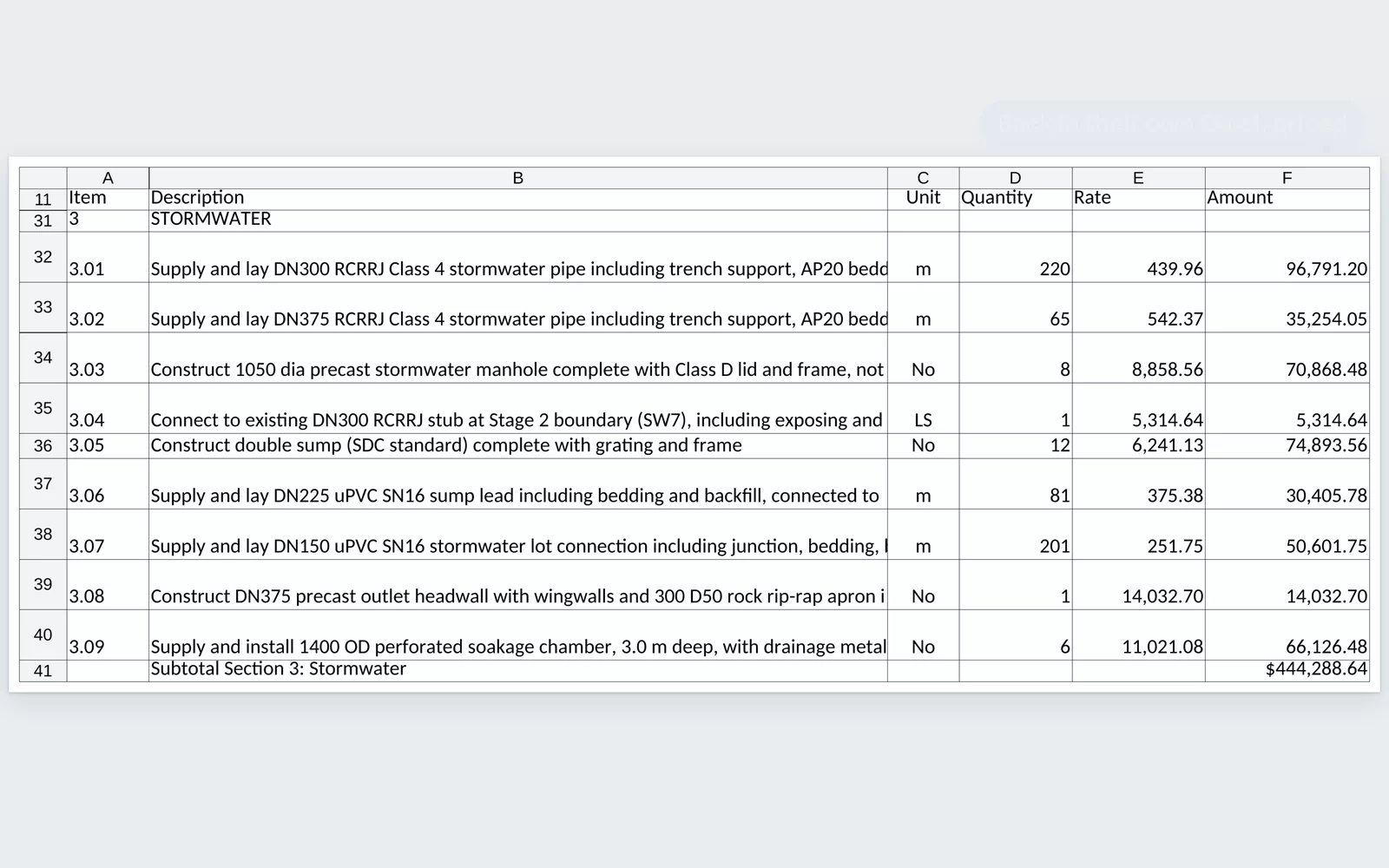
Recorded in Stralos: the client’s own workbook with section 3 priced, 3.01 at NZ$439.96 a metre. Example job and rates.
A footpath, by hand. Here’s the sum for 100 m of 1.5 m wide path, 100 mm of concrete on 75 mm of AP20. In Stralos that’s one area and one Volume calculation with two layers. Wastage, the edge boxing and the joints are yours to add.
Worked example, not a recording
| Area | Depth | Works out at | |
|---|---|---|---|
| Path area | 100 m × 1.5 m | 150 m² | |
| Concrete | 150 m² | 0.100 m | 15.00 m³ |
| AP20 basecourse, compacted | 150 m² | 0.075 m | 11.25 m³ |
What Stralos doesn’t do. There’s no dedicated kerb, concrete or reinforcing calculator: kerbs, paths and slabs are measured in takeoff, and their dig and layers worked out in the Volume calculator. It doesn’t produce bar schedules or read structural models.
What you start with
Sign up as “Concrete” and your rate library starts with 16 categories, among them Ready-mix concrete, Reinforcing steel, Formwork and Concrete pump. Your takeoff starts with Footings, Slabs, Walls, Paths & Driveways, Kerb & Channel and Retaining. An admin can add the civil starter categories too, such as Concrete Services and Saw Cutting & Core Drilling. It holds your own rates and your suppliers’ price lists. Ask us and we’ll load your price list into your rate library for you.
Questions
Does Stralos work out concrete volumes?
Yes, as a layer in the Volume calculator, by length, width and depth or by area and depth, or as m³ per m² in a slab activity. There’s no dedicated kerb or concrete calculator.
How do I price kerb and channel by the metre?
Measure the kerb lines, set the production rate in metres a day, and add the machine or boxing, the basecourse, the concrete and the backfill as costs. The cost per metre follows, and moves when the production rate does.
Can I allow for small load charges?
Yes. A supplier’s price can carry quantity breaks, a minimum charge and loadings, so a small pour is priced the way the plant bills it.
Can I quote a driveway or a slab without a tender?
Yes. Choose a quote when you set up the job. On Lite a quote takes up to 10 priced lines, each built from as many costs as it needs.
Last reviewed
Price your next concrete job in Stralos.
Free on Starter: everything in Standard for one person, with up to 5 active projects and 2 AI reviews a month. No card. When you add people or go past 5 active projects, Standard is NZ$199 per user per month + GST. Lite, for quotes, is NZ$99 + GST.